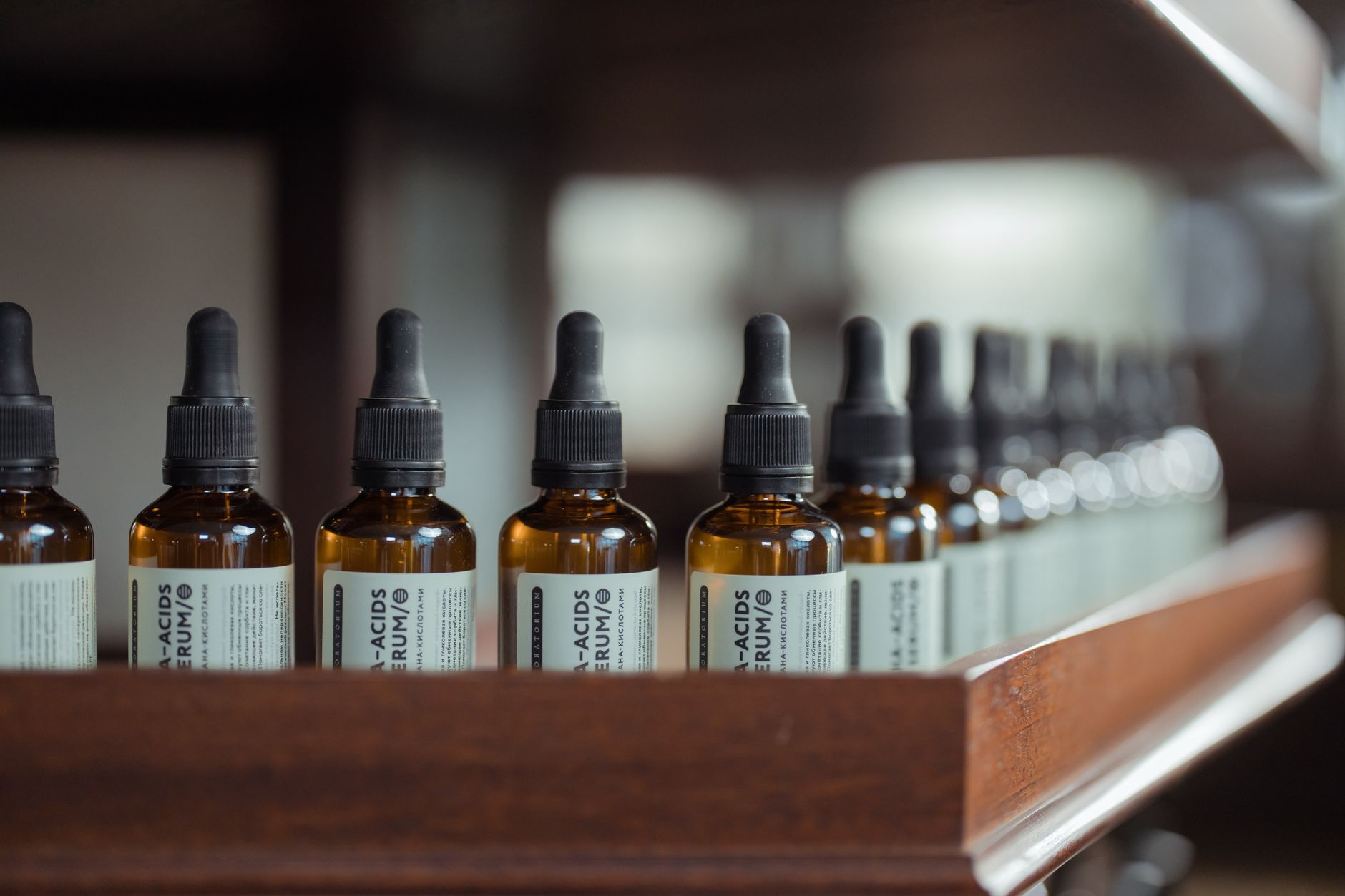
The pharmacy shelf on file, in one paragraph
The five French pharmacy must-haves on file are the products I have re-bought across eight years of daily use — French pharmacy skincare in the specific sense of a product sold behind the counter of a French pharmacie (the corner shop with the green cross), formulated by a house that publishes its thermal spring source, its lead active ingredient, and its full INCI in the language of the country the product is sold in. I have used and re-purchased eleven such products across the five houses in this dossier, and the sample set is what has actually survived my morning shelf rather than what a Sephora endcap has recommended. Retail prices in the file run from $18 for an Embryolisse Lait-Crème Concentré 30 ml tube to $155 for a Caudalie Premier Cru La Crème 50 ml jar. Two houses (Avène 1990, La Roche-Posay 1975) center their range on a named thermal spring with a documented mineral profile; two (Nuxe 1957, Embryolisse 1950) center on a single hero product that has stayed in continuous production since a specific decade; and one (Caudalie 1995) centers on a single active molecule patented at a specific French university.
What “French pharmacy skincare” actually names, at the shelf level
Before the specimen index, a note on the category boundary. French pharmacy skincare is not a marketing tier — it is a distribution and regulation tier. To sit on a French pharmacie shelf, a product must clear four gates that a US drugstore does not enforce equivalently: EU Regulation 1223/2009 on cosmetics (which prohibits about 1,700 ingredients versus roughly 30 in the US); AFSSAPS / ANSM dermatological safety review for the medical-adjacent category; pharmacist gate-keeping at the counter (the pharmacist can and does recommend one brand over another based on the customer’s actual skin condition); and traceability of the active ingredient back to a documented source — a spring, a plant extract, a lab-synthesized molecule — with a published purity spec.
That fourth gate is what makes the category legible. When Avène cites its Eau Thermale d’Avène at the source in Aveyron, or La Roche-Posay cites its selenium-rich spring at Vichy documented since 1617, or Caudalie cites resveratrol extracted from vine stems at Château Smith Haut Lafitte in Bordeaux, they are naming a specific location and a specific mineral or plant profile you can look up. Direct-to-consumer skincare brands sold in the US in 2026 rarely cite anything more specific than “high-quality ingredients” — a category invisible in this file. The same maker-mill discipline I apply to bed linen is what a French pharmacy label wears on its packaging as a matter of course.
The one working number worth carrying: for a daily-use French pharmacy routine, cleanser + spring water spray + serum + moisturizer + occlusive oil costs roughly $95-140 total for a 3-4 month supply, working out to $1.10-1.55 per day. Every brand in this dossier fits inside that envelope with the exception of the Caudalie Premier Cru line, which is the anti-aging heirloom tier.
Specimen index — TQC-2026-B002
The five pharmacy houses on file, cross-referenced at the spring, active ingredient, and price level:
| Maker | Origin & founding | Lead active | Signature product | Retail range (2026) |
|---|---|---|---|---|
| Avène | Aveyron, France · 1990 (spring 18th c.) | Thermal spring water (silica-rich) | Eau Thermale spray | $18–45 |
| La Roche-Posay | Vichy region, France · 1975 (spring 1617) | Selenium thermal water | Cicaplast Baume B5 / Toleriane | $20–50 |
| Caudalie | Bordeaux, France · 1995 | Grape polyphenols + resveratrol | Vinopure serum / Premier Cru | $30–155 |
| Nuxe | Paris, France · 1957 (relaunched 1989) | Multi-plant oils + honey | Huile Prodigieuse / Rêve de Miel | $25–90 |
| Embryolisse | Paris, France · 1950 | Aloe + beeswax + shea | Lait-Crème Concentré | $18–30 |
Two working numbers worth carrying from this table:
- Founding year does not equal continuous formulation. Nuxe was founded in 1957 but was reformulated and relaunched under Aliza Jabès in 1989; the Rêve de Miel honey balm has been in continuous production since 1991, and Huile Prodigieuse since 1991 as well. Embryolisse’s Lait-Crème Concentré has been produced continuously since 1950 with only three formulation adjustments on record. That continuity is the reason the makeup-artist community in Paris still stocks a case of Embryolisse tubes at every fashion week — the product does the same thing it did in 1970, on the same list of five main actives.
- The spring is the trust signal at the pharmacy tier. Avène’s Eau Thermale is bottled at the source and shipped in aerosol cans without preservatives; La Roche-Posay’s is the same discipline but with a different mineral profile (selenium-forward versus silica-forward). Those two brands can and do publish clinical trial data on the water itself — a spec transparency that direct-to-consumer competitors cannot match because they have no source to cite.
Reading a French pharmacy label the way an archivist reads a specimen
Six details I check on any French pharmacy product before it earns a catalog number:
- Full INCI declared in the English language on the box side. French export packaging is required to list the full International Nomenclature of Cosmetic Ingredients; the top 5 actives are what actually do the work, and the position of a hero ingredient in that list tells you how much of it is really in the tube.
- Spring or plant source cited by name. “Thermal water” is meaningless without a source; “Eau Thermale d’Avène — source Sainte-Odile” is a specific place with a documented mineral profile you can look up in the ANSM archive.
- Preservation system disclosed. French pharmacy skincare generally avoids parabens, phenoxyethanol above 0.4%, and MIT / MCI (methylisothiazolinone family). If a label doesn’t disclose the preservation system, the pharmacist behind the counter will not stock it in the first place.
- Dermatology co-signature or clinical study cited. Avène, La Roche-Posay, and Caudalie all publish peer-reviewed clinical studies on their hero products. The study reference number belongs on the outer carton or the product page. Absent that, treat any “clinically tested” claim as marketing.
- Recyclable primary packaging with the resin code. The French loi anti-gaspillage (Article 15 of the 2020 waste law) has pushed nearly every heritage French pharmacy brand to switch to mono-material aluminum or PP tubes since 2022. If the tube is still mixed-material laminate, the brand hasn’t updated.
- Country of manufacture: France (in most cases) or Belgium. Nuxe manufactures in Chartres, France. Embryolisse manufactures in Val-de-Marne, outside Paris. La Roche-Posay and Avène manufacture at the spring sites themselves. Caudalie manufactures at multiple French sites plus a certified Portuguese facility. Any “French pharmacy” brand made in Asia should be reclassified — Asian-manufactured OEM white-label under a French-sounding name is a category worth naming and staying out of.
Three tiers of entry into the French pharmacy catalog
Three tiers, arranged by budget and by how much of the spring or lab you are paying for.
Embryolisse Lait-Crème Concentré (Val-de-Marne, founded 1950 by Dr. Tapernoux as an in-house dermatology cream at his Paris clinic) and Nuxe Huile Prodigieuse (Paris, formulated 1991 by Aliza Jabès) sit at the entry tier of French pharmacy skincare. Both are single-hero-product houses — Embryolisse’s Lait-Crème has been the same formula since roughly 1970 (only a preservative-system update in 2016 on record), and Huile Prodigieuse has been the same 6-oil blend since 1991. The makeup-artist community stocks Embryolisse at every fashion week in Paris, Milan, and New York because it is the one product on the shelf that primes, moisturizes, and calms in a single 30 ml tube.
Filed since 2018 (Embryolisse Lait-Crème 75 ml tube, replaced every 4 months) and 2019 (Nuxe Huile Prodigieuse Or, the shimmer version, 50 ml, replaced every 8 months). The Embryolisse tube has not changed color or scent across 24 replacement cycles; the Huile Prodigieuse has migrated from the shimmer version to the plain version and back twice, which is user error, not product drift.
The entry-tier trade-off is that neither product has a serum step — both are moisture-and-oil products, not treatments. Add the mid-tier below to get the treatment layer.
Avène (Aveyron, France, founded 1990 as a division of the Pierre Fabre dermatological group; the spring at Sainte-Odile has been documented since the 18th century) and La Roche-Posay (Vichy region, France, founded 1975 as a division of the L’Oréal dermatological group; the spring documented since 1617) are the mid-tier reference houses of French pharmacy dermatology. What you get at $18-50 per product: a named spring with a published mineral profile (Avène silica-rich, La Roche-Posay selenium-rich), peer-reviewed clinical trial data on the flagship products, and a pharmacist-vetted formulation that clears the EU Regulation 1223/2009 gate.
Filed since 2020 (Avène Eau Thermale 300 ml spray, replaced monthly) and 2021 (La Roche-Posay Cicaplast Baume B5, 40 ml tube, replaced every 3 months). The Avène spray is the single most-repurchased product in this file — 34 cans in 5 years — because it is the one product I do not travel without. The Cicaplast has fixed 200+ minor skin injuries in the same period (paper cuts, sunburn edges, post-retinol irritation) without a single reaction.
The mid-tier trade-off is that neither brand carries a strong anti-aging treatment line. La Roche-Posay’s Retinol B3 comes closest but is a supporting-cast product, not a hero. For the anti-aging tier, go to the heirloom tier below.
Caudalie (Bordeaux, France, founded 1995 by Mathilde Thomas and Bertrand Thomas at Château Smith Haut Lafitte, still family-operated) is the anti-aging heirloom of French pharmacy skincare. The founding proposition was to extract resveratrol — the polyphenol Bordeaux vine stems produce against oxidative stress — under a research partnership with the University of Bordeaux, and to build a full skincare range around it. Premier Cru La Crème is the flagship: resveratrol + vine polyphenols + hyaluronic acid + peptides, in a 50 ml jar that lasts 3-4 months of daily use, published clinical trial data on the anti-aging endpoint. The Vinopure line is the acne-tier product below the Premier Cru, which shares the polyphenol chassis at a lower price.
Filed since 2022 (Caudalie Vinopure Skin Perfecting Serum, 30 ml, replaced quarterly) and 2024 (Premier Cru La Crème, 50 ml, gifted). At two years of use the Premier Cru cream has stabilized my late-30s under-eye texture, and the Vinopure has kept the pore density on my nose consistent through two US summers.
The heirloom-tier trade-off is price: at $155 for 50 ml, Premier Cru is a $1.30-per-day product at a 4-month replacement cycle. That is the top of the file. Below Premier Cru, Caudalie’s Vinoperfect serum ($85) is the second-most-cited Caudalie product and the price-per-durability sweet spot within the brand.
How I use the specimens on file
The five-brand French pharmacy routine at daily-use scale:
- Morning: Avène Eau Thermale spray, 3 seconds, on damp skin. The spray is the reset button — pure thermal water, no additives, works as a rinse-off primer and as a post-cleanse pH restorer.
- Cleanse: La Roche-Posay Toleriane Dermo-Cleanser or Caudalie Vinoclean, depending on the season. In winter Toleriane’s oil-free cream cleanser is gentler; in summer Vinoclean’s foaming gel handles Los Angeles heat better.
- Serum: Caudalie Vinopure (spot) or Vinoperfect (all-over). Serum step is where the treatment ingredient goes — for me, salicylic acid from Vinopure on the T-zone, resveratrol from Vinoperfect for radiance on the cheeks.
- Moisturize: Embryolisse Lait-Crème Concentré, three pumps. The Embryolisse tube is the anchor of the routine — it moisturizes, primes for makeup or SPF, and calms retinol irritation the night after.
- Occlude at night: Nuxe Huile Prodigieuse, one pump. The oil layer seals the moisture underneath. On low-humidity Los Angeles nights the Huile Prodigieuse Or (with mica shimmer) doubles as a body oil after shower.
- Anti-aging cadence: Caudalie Premier Cru La Crème, morning only, 3-4 pumps. This is the once-a-day investment product — the Premier Cru replaces the Embryolisse layer on mornings I want the anti-aging treatment forward.
The one working spec worth noting: this routine takes 90 seconds in the morning and 120 seconds at night, top to bottom. Anything longer than that fails the daily-use test at year three.
Living with a French pharmacy shelf
Two things about an eight-year French pharmacy routine that changed how I think about skincare:
- The pharmacist gate matters. In France, the pharmacist at a corner shop asks what skin condition you are working on and recommends a specific brand and product based on the ANSM approvals stack, not on shelf placement. That gate is what filters out the mass-market direct-to-consumer noise that fills the US drugstore aisle. When I re-stock from a Paris pharmacie versus a US CVS, the recommendation quality difference is measurable in about 20 seconds. This is why the file exists — it is what a Paris pharmacist would file if a Paris pharmacist had a catalog.
- The category rewards patience over novelty. Every product in this dossier has been in production for at least 15 years (Caudalie Vinopure) up to 75 years (Embryolisse Lait-Crème). The routine gets better as the skin acclimates to the ingredient stack — that is the exact opposite of the algorithmic-skincare tier, where the whole point is to churn through a new hero ingredient every quarter.
If you have read my note on single-ingredient skincare brands, you know the trust-signal framework. French pharmacy skincare adds one more axis — pharmacist gate-keeping — that the direct-to-consumer single-ingredient tier does not have. Both frameworks converge on the same conclusion: spec transparency plus a decade of continuous formulation is what a shelf worth filing looks like.
Frequently asked questions
What are the French pharmacy must-haves? The peer-cited essentials across long-form French-pharmacy reviewers in 2026 are: La Roche-Posay Cicaplast Baume B5 (universal repair balm, $16-20); Avène Eau Thermale spray (thermal water reset, $18-32); Embryolisse Lait-Crème Concentré (makeup-artist moisturizer / primer, $18-30); Nuxe Huile Prodigieuse (dry oil, $28-52); Bioderma Sensibio H2O (micellar cleansing water, $15-20). Add Caudalie Vinopure Skin Perfecting Serum ($40-55) if you want a treatment-serum step. That six-product stack is what most Paris-based makeup artists and dermatology clinics keep on the counter, and what this dossier files as the reference stack.
What French pharmacy skincare is best? By peer citation across long-form reviewers in 2026, the top of the category is: La Roche-Posay Cicaplast Baume B5 (universal repair balm, $16-20 · used by dermatologists worldwide); Avène Eau Thermale spray (thermal water reset, $18-32 · universal-skin); Caudalie Premier Cru La Crème (anti-aging cream, $155 · the heirloom investment); Embryolisse Lait-Crème Concentré (makeup-artist primer, $18-30 · universal-skin); Nuxe Huile Prodigieuse (dry oil, $28-52 · universal-skin). Below that tier: Bioderma Sensibio H2O (micellar water, $15-20) is the most-cited entry to the category. Best depends on the specific skin condition you are treating.
Why is French pharmacy skincare so popular? Three things converge: (1) EU Regulation 1223/2009 bans about 1,700 ingredients versus roughly 30 banned in the US, so the baseline safety floor is higher; (2) French pharmacies stock only products that clear ANSM dermatological review and pharmacist vetting, filtering out mass-market noise; (3) heritage brands (Embryolisse 1950, Nuxe 1957, La Roche-Posay 1975, Avène 1990) have kept single hero formulations in continuous production for 30-75 years, so the trust signal compounds over time. Compare that to the US direct-to-consumer skincare category, where the median brand age is under 8 years and the top-shelf hero is often on its third reformulation.
What’s the difference between French pharmacy and drugstore skincare? “French pharmacy” (pharmacie) is a regulated retail channel where the pharmacist gate-keeps and only ANSM-cleared products stock the shelf. “US drugstore” (CVS, Walgreens) is an unregulated retail channel where products stock based on distribution agreements and consumer marketing. The consequence: a French pharmacy price of $22 for La Roche-Posay Cicaplast maps to roughly $18-20 at a US drugstore, but the surrounding shelf context is completely different — a French pharmacie will not stock the direct-to-consumer indie brands next to it, while a US drugstore stocks everything the distributor sends.
Is French pharmacy skincare worth it? For the categories where French pharmacy has genuine advantage — cicatrisant repair balms, thermal water sprays, single-active serums, gentle universal moisturizers — yes, unambiguously. La Roche-Posay Cicaplast Baume B5 at $18 has no peer at that price in the US. Avène spray at $22 for 300 ml has no peer either. For anti-aging treatments above $100 per jar, the calculus is closer — Caudalie Premier Cru works well but so do peer products at similar prices from Sisley or from the higher end of the US dermatology brands. Below $50 per product the French pharmacy tier is the durable choice.
What do French dermatologists recommend? The most peer-cited brands in French dermatology practice (2026 industry surveys): La Roche-Posay, Avène, Bioderma, Ducray, Eucerin (Beiersdorf, German-owned but part of the pharmacy shelf), and A-Derma. Below that first tier: SVR, Uriage, Noreva, Topicrem. The recommendation logic is that these brands publish clinical trial data, clear the ANSM gate, and hold long-term formulation consistency — a French dermatologist will not rotate patients through a novel indie brand every quarter.
Where can I buy French pharmacy skincare in the US? Direct sourcing options in 2026: (1) each brand’s US site sells the flagship products with US-formulated versions where required (Avène.us, LaRochePosay.us, Caudalie.com/us, Nuxe.com/us, Embryolisse.com/us-en); (2) US pharmacies including CVS, Walgreens, and Target now stock the top 5 French pharmacy brands at prices $2-6 above French retail; (3) Sephora and Ulta stock Caudalie and Nuxe reliably, plus a subset of La Roche-Posay; (4) US Amazon carries all five houses but risk of gray-market older stock is real — check the seller name, prefer “Ships from and sold by Amazon.com” or the brand’s official Amazon storefront. For French-formulation-exact products (which sometimes differ from US-formulated in preservative system), a Paris-based mail forwarder is the most reliable route.
Read next
- Cataloged - Single-ingredient skincare brands — the beauty pillar’s opening entry.
- Cataloged - Heritage bed linen brands — same trust-signal discipline applied to a different category.
- Filing conventions of the catalog — how entries earn their place.
- Publishing standards — what the catalog earns, what it does not.