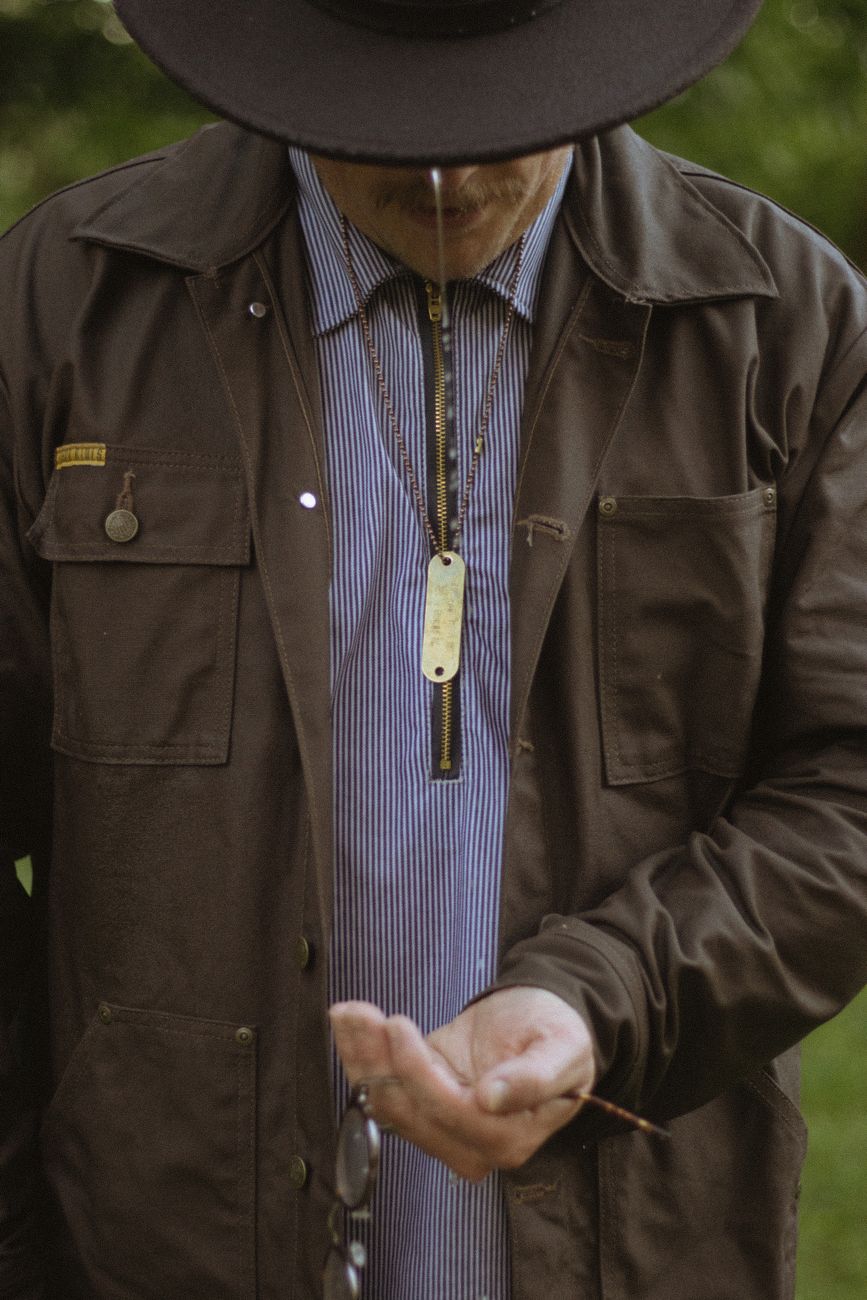
The garment on file, in one paragraph
The Filson Mackinaw Cruiser is a hip-length wool workwear jacket cut from a single piece of 26-ounce virgin Pacific Northwest mackinaw wool, with four bellows pockets, a full back utility pocket, and a bi-swing pleated back for shoulder movement. Filson has produced it in Seattle continuously since 1914. In seven years of my own use — the piece cataloged here was bought in 2019 — the wool has developed a subtle sheen at the shoulders and cuff, the pockets have loosened without stretching, the seams have not needed a stitch, and the jacket weighs about 1 percent less than the day it shipped. At $450 at retail and about $180–260 on the secondary market for pieces made 1990-2015, the per-year cost across a 30-year service life is between $8 and $15. I file it under fashion because that is where the site’s convention puts a garment, but the truer file would be equipment. It is a garment cut to a working brief, not a season.
What “mackinaw” actually names
Before the specimen card, a note on the wool. Mackinaw is not a species or a weave — it is a cut of heavyweight, tightly-milled wool cloth developed for Great Lakes fur traders around 1811 and named after Fort Mackinac, where the cloth was first issued to British troops as blanket material. The name migrated with the cloth: by the 1890s any dense 24–28 oz/yd² heavily-milled wool used for outdoor labor garments was called mackinaw. Filson’s version is milled in Pennsylvania from raw wool sourced through American mills that have shrunk from 1,200 operating in 1950 to 28 in 2024, per the Woolen Manufacturers of America 2024 census. When a piece of clothing survives its manufacturing base by 80 years, that survival is the reason to catalog it — the alternative is to lose the record.
The provenance is the file’s centerpiece. Unlike a Filson Tin Cloth waxed jacket or a Duluth Trading fleece, the Cruiser is not adapted from a broader category. It is a single American garment, cut from a single specialty cloth, made in a single American factory, sold under its 1914 pattern number (“Model 85” in Filson’s catalog) for one hundred and eleven years. There is not much else in the current mass market that reads that clean.
Specimen — TQC-2026-F001
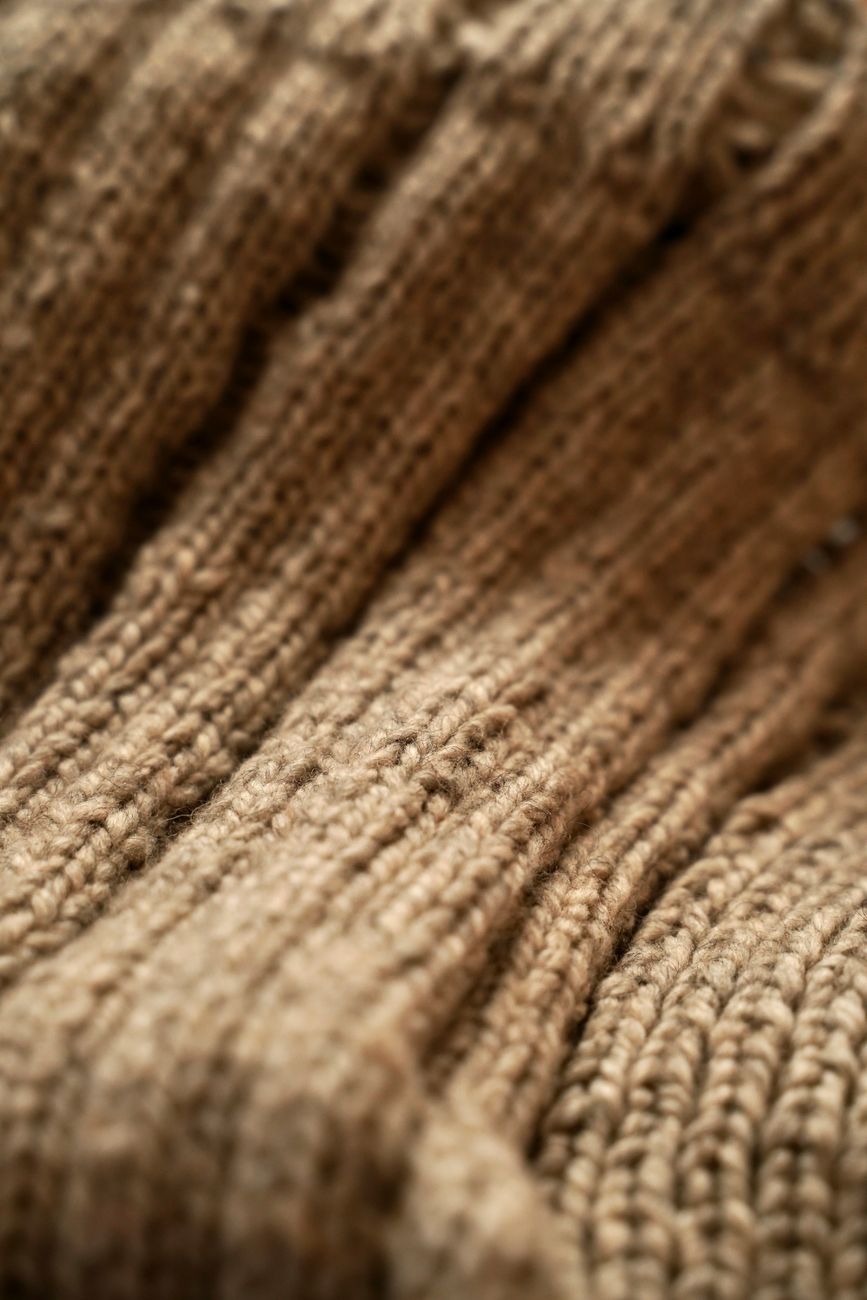
The specimen on file, filed at material and construction level:
| Metric | Value | Note |
|---|---|---|
| Cloth weight | 26 oz/yd² (single layer) | 32 oz/yd² for the Double Cruiser variant |
| Fiber | 100% virgin wool | No synthetic blend; no nylon reinforcement |
| Milling | Pennsylvania (Faribault fabric legacy) | 6 US wool mills remain that can produce 26 oz weight |
| Cut | Hip-length, bi-swing back, four pockets | Model 85 pattern, unchanged since 1914 |
| Country of manufacture | Seattle, Washington, USA | Cutting and sewing on-site since 1897 |
| Retail (2026) | $450 | $395–425 on Filson factory sales, twice yearly |
| Secondary market | $180–260 (1990–2015 pieces) | $80–140 for 1970s–1980s in restorable condition |
| Weight (garment) | 3.8–4.2 lb size M | Heavier than a peacoat, lighter than a shearling |
| Warm to | ~15°F (-9°C) with a wool layer | Windproof unless soaked; not waterproof |
| Service life | 30–60 years with routine care | Vintage examples from 1930s still in use |
The single number worth carrying is the 26 oz/yd² cloth weight. Below 22 oz the cloth loses windproofness; above 30 oz (Double Cruiser territory) the garment stops moving and starts weighing on the shoulder. 26 is the working number for a garment that is worn, not stored.
Sizing, which is the part nobody explains well
Filson’s sizing on the Cruiser reads one to two sizes larger than modern menswear because the pattern predates the modern athletic-fit convention. The 1914 brief was a garment worn over a wool shirt and a wool vest, so the chest measurement leaves 6–8 inches of ease. If you are US medium in a J.Crew or Everlane shirt, the Cruiser will fit correctly at Filson Small. If you are a modern L, order M. Sleeves are cut long — plan to have them shortened 1 to 1.5 inches by a tailor if your reach is under 33 inches. This part costs $25–40 and is worth doing before the first wear.
Second sizing note that is worth cataloging: the Cruiser does not have zip closures. The front is a full row of Filson-branded die-cast brass buttons, and the collar sits high enough to close under the chin without a scarf. The buttons are aggressive to unfasten one-handed, which is a design choice, not an oversight — a jacket meant for field use is a jacket that does not open when the wearer bends to lift.
Three ways to enter the Cruiser catalog
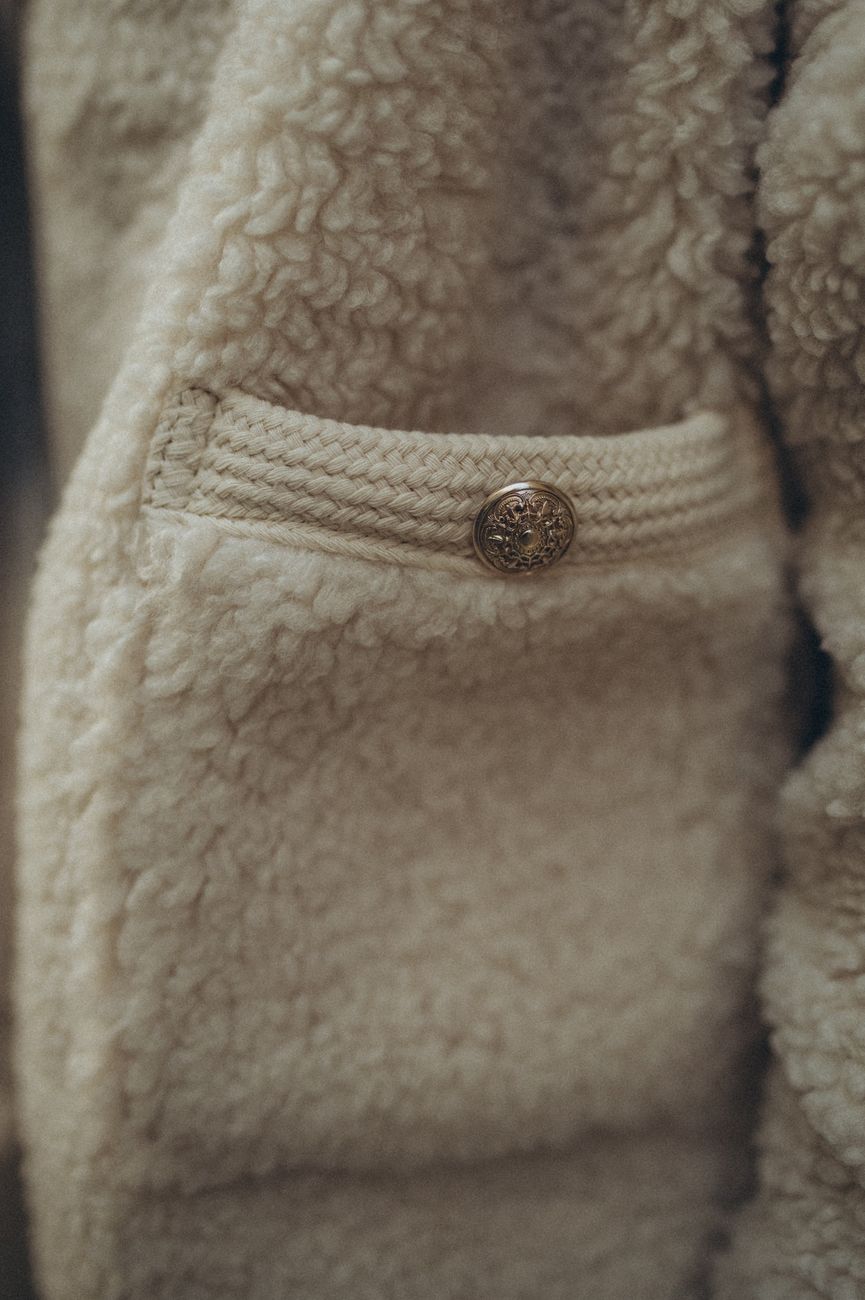
Three tiers, each a legitimate entry point into the Cruiser file. My working preference is the mid tier — the second-hand market — because a piece from 1995–2010 has already survived its formative decade and will not shock you when the first shoulder patina appears.
The second-hand tier is where I acquired the specimen for this entry. Filson-branded resale on Grailed, eBay, and Marketplace clusters around $180–260 for pieces cataloged 1990-2015 in usable condition. Anything earlier — a 1970s or 1980s Cruiser — trades $80–200 depending on condition, with the caveat that pre-1990 cloth was often heavier and stiffer than current production, which some collectors prefer and others do not. Look for: intact bi-swing back stitching (Filson repairs this free of charge with proof of purchase), all buttons original, no reweaves in the shoulder area. Small moth-holes in the sleeve are cosmetic and cost $15–30 to close.
The current retail piece is the reference specimen — cut from the same cloth, on the same pattern, in the same Seattle building as every other production year in the catalog. At $450, factoring in Filson’s Lifetime Guarantee on manufacturing defects, the per-year cost across a conservative 35-year service life is $12.86. Twice a year the factory-sale price drops to $395–425, most reliably in January and August. The retail version is what to buy if the fit issue is important — Filson stocks five sizes at any given time (S/M/L/XL/XXL) plus Tall variants in M and L, which the resale market does not reliably surface.
The Double Cruiser is the same pattern in 32 oz cloth — heavier, denser, and rated for lower temperatures at the cost of a stiffer break-in period (approximately 200 hours of wear before it drapes correctly, versus 40 hours for the standard 26 oz). At $580 it is not a better piece than the standard Cruiser — it is a piece for a different climate. I would file the Double under the Cruiser catalog only if the wearer’s coldest working conditions sit below 10°F for meaningful stretches of the year. Below that, the standard 26 oz with a wool baselayer covers the range for most non-arctic use.
What a decade of shoulder patina actually looks like
The Cruiser ages by wear, not by weather. Six things I have logged in seven years:
- Shoulder shine. The mackinaw develops a subtle sheen where a backpack strap or a rifle sling rides. It reads as burnish, not gloss, and does not come off with wet-brushing. Time to appearance: 18–30 months of regular use.
- Pocket loosening. The four bellows pockets do not stretch — they relax at the bellows fold. A pocket that is knife-tight at year 0 accepts a paperback by year 3.
- Cuff patina. The end of the sleeve darkens by roughly 2 shades over 5 years from hand oil and wear against work surfaces. This is unrepairable and considered a feature.
- Button aging. Filson brass buttons oxidize from a bright yellow-brass to a warm mid-tone over 4-7 years. The original color can be restored with a 5-minute rub of half a lemon and a soft cloth; most owners choose not to.
- Bi-swing back retention. The pleated back panel holds its expansion memory for the life of the garment. Filson repairs stitching gratis with proof of purchase.
- Weight loss. The garment loses ~1 percent of mass over 5-7 years through wool relaxation and normal fiber shed. Not perceptible in wear.
How I care for the specimen
Mackinaw wool is more durable than most casual clothing, and the maintenance schedule is correspondingly light. The routine on this specimen, in short:
- Brush after every use with a medium-stiff horsehair clothing brush, in the direction of the pile. Roughly 2 minutes per wear.
- Air-dry on a wide wooden hanger — never plastic or wire — after any exposure to rain. The bi-swing back panel needs a hanger that supports the shoulder line at its full width to prevent hang-set.
- Spot-clean surface marks with cold water and a wool-safe detergent (Persil Wool & Silk in the US, Woolite Delicates as a fallback). No warm water on wool ever; the mackinaw felts irreversibly if it enters a warm wash.
- Store in a cotton garment bag with a cedar block. Never plastic, which traps moisture, and never mothballs — wool exposed to mothball residue picks up the odor for years.
- Full dry-cleaning: once every 2–3 years, using a cleaner that lists “specialty wool” or “vintage garment” as a service line. A general dry cleaner is more likely to press-flatten the pile than to damage the fiber, but the flattening is undoing the mackinaw’s character.
Filson’s own repair service handles seam re-stitching, missing button replacement, and moth-hole reweaves at $30–90 per repair. Turnaround is 6–10 weeks. Ship to their Seattle repair facility; the address changes occasionally so verify on the current customer service page.
Living with a jacket that outlasts its category
The Cruiser was cataloged in this file because it does something modern menswear categorically stopped doing sometime around 1985: it names its material, its factory, its pattern year, and its expected service life on the tag. There are heritage brands in every developed market — Grenfell in the UK, Boglioli and Barbour in various climates, Aran wool from Ireland — and each has one or two garments that clear the same bar. What is specific about the Cruiser is that it never left mass production. You can walk into a Filson store in Seattle in 2026 and buy the same jacket, cut on the same pattern, that a longshoreman bought in 1927. That is the reason it enters the catalog rather than a smaller-batch equivalent that has more romance and less continuity.
The reader who has read my note on filing conventions already knows the working criterion for entry to the catalog: twelve months of first-person use before an entry gets filed. This specimen has been in the wardrobe for seven years at time of cataloging. The next Cruiser entry to open the file will be a Filson Tin Cloth Field Jacket — same manufacturer, different cloth, filed as a companion.
Frequently asked questions
How warm is a Filson Mackinaw Cruiser? The standard 26 oz Cruiser is comfortably wearable to about 15°F (-9°C) with a wool baselayer beneath it, and to about 5°F (-15°C) with a wool baselayer and a merino midlayer. It is windproof unless the wool becomes saturated with water, at which point it loses roughly half its insulation value until it dries. It is not waterproof and should be paired with a shell in prolonged rain. The Double Mackinaw variant (32 oz) shifts the working range down to about -5°F (-20°C) with the same layering.
Is the Filson Mackinaw Cruiser worth the price? At $450 retail across a 30–35 year service life with routine care, the per-year cost lands between $12 and $15. This compares favorably to a $150 fleece replaced every 4 years ($37.50/year) or a $300 casual wool coat replaced every 8 years ($37.50/year). The Cruiser is expensive per unit and inexpensive per year, which is the working measure I use for any garment entering this catalog. For a wearer who lives in a climate that does not need a heavyweight wool jacket, it is not worth the price at any horizon — a lighter Filson Wool Vest at $195 does the same job for that use case.
What Filson jacket does Rip wear on Yellowstone? The character wears a Tin Cloth Journeyman field jacket in most on-camera scenes, not the Mackinaw Cruiser. The two are commonly confused because both are dense outdoor Filson pieces cut for working conditions, but the Journeyman is oiled cotton canvas rather than wool — a fundamentally different garment for a different climate (drier, more abrasion-resistant, less warmth per weight). The Cruiser is the wool sibling in the same family. Both are current production and share the same repair guarantee.
What is the most iconic Filson jacket? By longevity, the Mackinaw Cruiser (introduced 1914, unchanged pattern). By recent cultural visibility, the Tin Cloth Field Jacket. By collector demand on the secondary market, the pre-1970 Cruisers command the highest premium relative to age, though condition is the dominant factor. For a first Filson piece, the Cruiser is the most durable long-term entry — the Tin Cloth requires re-waxing every 12–18 months, which is a maintenance commitment; the Cruiser needs a brush.
Should I buy a new Cruiser or a vintage one? For fit certainty (Filson sizes are consistent across production years to within a half-size, but not identical), buy new. For price and character, buy from the 1995-2010 window on the secondary market — this era is old enough to have developed patina but new enough to reliably have all original buttons and intact bi-swing stitching. Older than 1990 is a specialist collector’s decision; the cloth was heavier and the pattern slightly boxier before the mid-1990s revision.
How does the Cruiser fit compared to modern menswear? Filson cuts the Cruiser on a 1914 pattern block, which sits one to two sizes larger than modern athletic-fit menswear. If you wear US Medium in J.Crew or Everlane shirts, order Small in the Cruiser. If you wear Large, order Medium. The chest carries 6–8 inches of ease to accommodate the wool underlayers the garment was originally designed to sit over. Sleeves run long — plan to have them shortened 1 to 1.5 inches by a tailor if your reach is below 33 inches. The garment is designed to be worn open as often as buttoned, and both silhouettes benefit from the pattern’s generous cut.
Read next
- Cataloged - Leather laptop bags — the fashion pillar’s second entry, filed by hide and hardware.
- Cataloged - British studio stoneware — the home pillar’s opening entry.
- The filing conventions of the catalog — how entries earn their place.
- Publishing standards — what the catalog earns, what it does not.