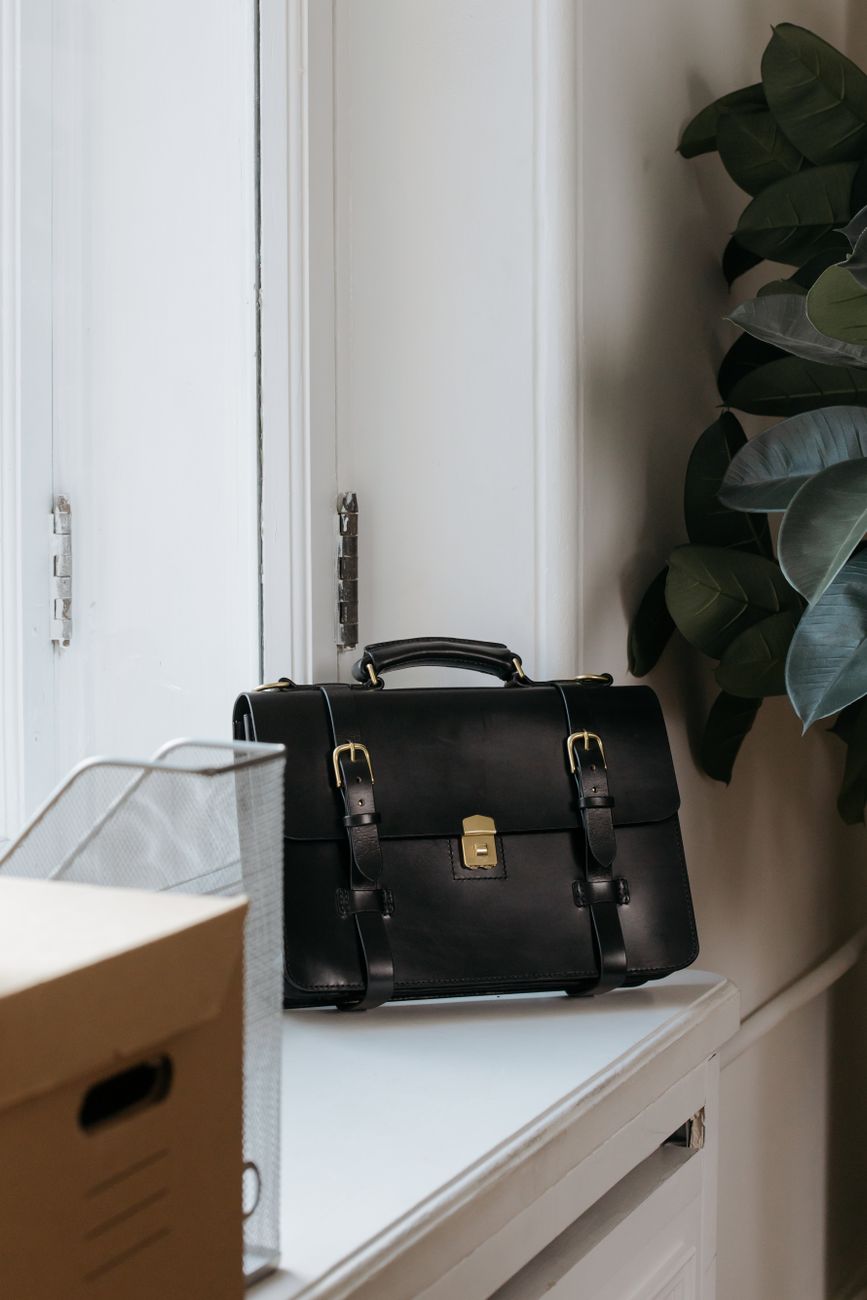
The bags on file, in one paragraph
Leather laptop bag, in this file, means a hip-height briefcase or messenger with a primary padded compartment sized for a 13- to 16-inch laptop, a hide grade you can name (full-grain vegetable-tanned, chrome-tanned, or oil-pull), and hardware that survives being dropped from a chair — solid-brass buckles, YKK Excella zippers, or riveted D-rings, not thin stamped alloy. I have carried around eight of these through airports and offices over the last eleven years, and the five in this dossier are the ones that made it past the year-three shoulder-strap-failure test — the point at which a bag either reveals its manufacturing shortcut or joins the long-term file. Retail prices in the file run from $285 at Buffalo Jackson’s Roosevelt to $2,800 at Ghurka’s vintage Marley collection. Weight ranges from 1.4 kg (Mahi minimalist) to 3.1 kg (Frank Clegg English Briefcase in harness leather). Insert accommodation runs 13” to 16” laptops; a proper bag holds the machine plus a notebook, a jacket, and a book without the strap complaining.
What “leather laptop bag” actually names, at the material level
Before the specimen index, a note on the classification. “Leather laptop bag” is at least three separate categories sold under one shelf label. Category 1 is the soft messenger — an unstructured or lightly-structured single-strap shoulder bag, typically vegetable-tanned pull-up leather that softens visibly at year two. Category 2 is the structured briefcase — a rigid or semi-rigid two-handle bag with a rolled or gusseted spine, harness-leather bodies, and heavy-duty hardware; this is what Frank Clegg or Ghurka make. Category 3 is the hybrid messenger-briefcase with both handles and a detachable shoulder strap; Buffalo Jackson’s Roosevelt and Saddleback’s Front Pocket sit here.
Each category ages differently. A Cat-1 soft messenger patinas fastest — the pull-up leather darkens visibly at year one and reads as “worked-in” by year three. A Cat-2 structured briefcase ages more slowly and more formally; the harness leather does not slouch, and the bag looks nearly identical at year five as it did at year one, only darker in the touch spots. A Cat-3 hybrid falls between the two. I file all three because the question “which laptop bag” turns out to mean “which category first, then which maker in that category” — the same trap the reader hits with leather notebooks.
The one working number worth carrying: for daily commute and travel, 13-14 inch laptop capacity plus a 3-cm expansion gusset is the size that survives. Anything smaller cannot hold a laptop plus a jacket; anything larger becomes a soft duffel that flops in the aisle. Every specimen below is 14” or 15” sleeved unless noted.
Specimen index — TQC-2026-F002
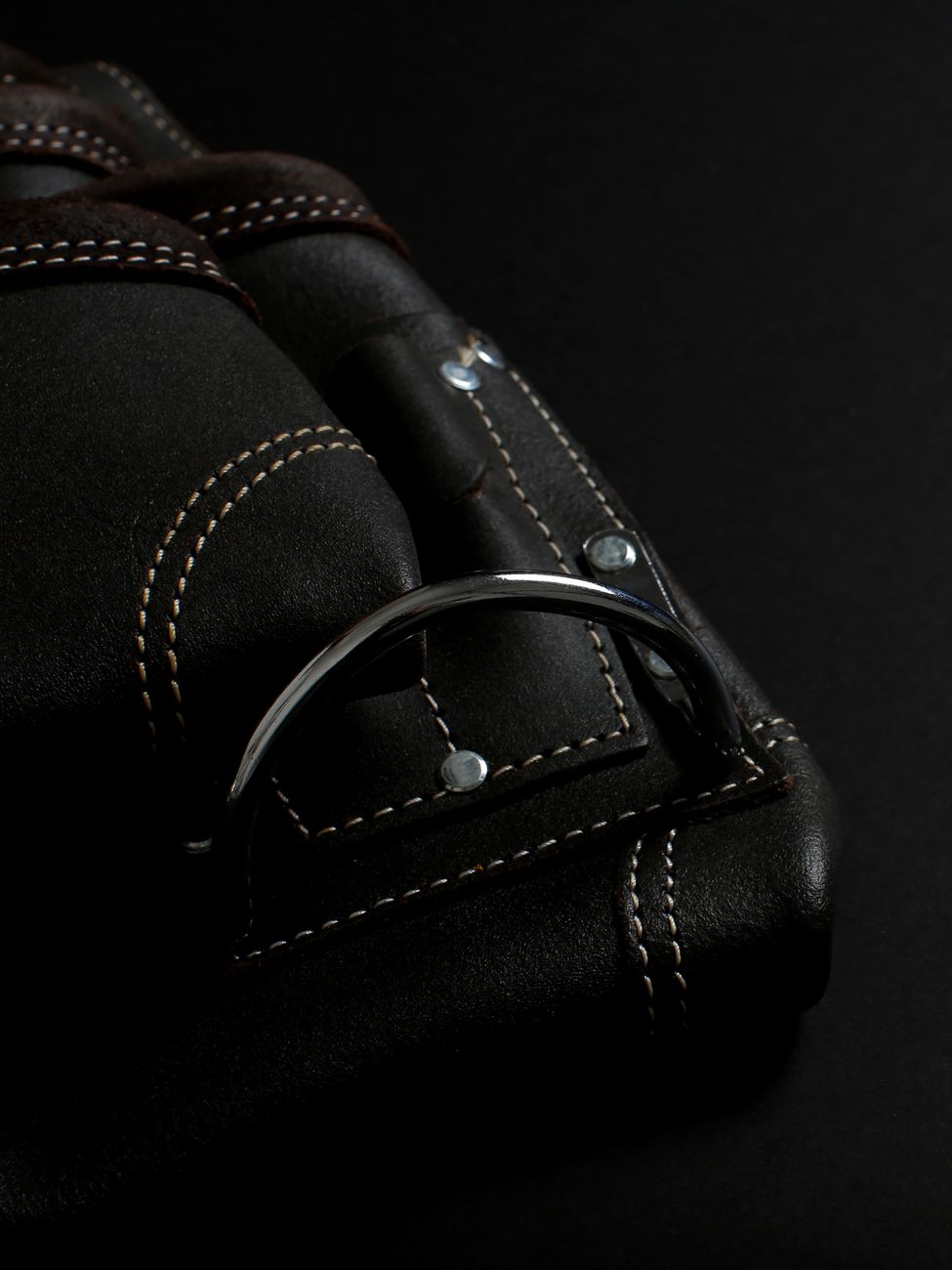
The five bag makers on file, cross-referenced at the material and construction level:
| Maker | Origin | Hide grade | Category | Retail range (2026) | Weight (14”) |
|---|---|---|---|---|---|
| Buffalo Jackson | Greensboro, NC, US · 2011 | Buffalo hide + Horween Chromexcel | Cat-3 hybrid | $285–425 | 1.9–2.4 kg |
| Mahi Leather | Nottingham, UK · 2013 | Italian full-grain veg-tan | Cat-1 messenger | £150–320 | 1.4–1.8 kg |
| Old Angler | Tuscany, Italy · 1962 | Italian veg-tan · hand-stitched | Cat-2 briefcase | €400–700 | 2.0–2.6 kg |
| Frank Clegg | Fall River, MA, US · 1984 | Wickett & Craig harness (American) | Cat-2 briefcase | $1,200–2,200 | 2.4–3.1 kg |
| Ghurka | Norwalk, CT, US · 1975 | Vachetta + Chestnut American hide | Cat-2 heirloom | $1,800–2,800 | 2.3–2.9 kg |
Two working numbers to carry from this table:
- Full-grain veg-tanned or harness leather is the material worth paying for. Every specimen in this file uses one of those two hide grades. Chrome-tanned corrected-grain — the material most $150 laptop bags on Amazon use — feels plasticky at week one and cracks at the fold corners by year three. Chromexcel (Horween’s oil-and-wax-treated combination tannage, used by Buffalo Jackson) is the exception: chromed for softness, hot-stuffed with waxes and oils to behave like veg-tan on patina.
- Hardware weight is the invisible spec. Solid-brass buckles run 35-60 g each; thin plated alloy runs 8-15 g. Weigh the bag empty; if it comes in under 1.4 kg for a 14-inch capacity, the hardware is under-engineered and will bend at the strap anchor within three years of daily commuting.
Reading a laptop bag the way an archivist reads a briefcase
Six details I check on any leather laptop bag before it earns a catalog number:
- Strap anchor construction. The shoulder strap attaches to the bag either via a D-ring riveted through the body leather (Buffalo Jackson, Ghurka), a solid-brass buckle bolted through a leather reinforcement patch (Frank Clegg, Old Angler), or a stitched-only nylon-webbing loop (cheaper Mahi lines, most Amazon brands). The stitched-only version fails first — the thread wears through under lateral shoulder load and the anchor rips out at year 4-7. Riveted D-rings and bolted brass buckles outlast the bag.
- Bottom construction. A structured briefcase has either a stitched-and-glued gusseted bottom (Old Angler, Ghurka) or a saddle-stitched wraparound bottom (Frank Clegg’s English Briefcase). Bags with a flat-panel bottom slump within a year under laptop weight; bags with feet or studs on the bottom leather survive being set down on wet pavement without waterlogging.
- Stitch density along the seam. A hand-saddle-stitched seam runs 6-8 stitches per inch with subtle tension variation between stitches (human, not machine). Machine stitching runs 10-12 per inch, perfectly even. Both are functionally durable; hand-stitching is worth paying for aesthetically and because it can be re-stitched by any leatherworker if the thread eventually fails.
- Interior compartment structure. Look for a dedicated padded laptop sleeve (foam or felt inside a fabric or leather-lined cavity), not just an open main compartment. The sleeve should be sewn into the body panels at both sides — sleeves attached only at the top edge slap around during walking and eventually tear at the seam.
- Zipper grade, where applicable. YKK Excella (metallic zip) or YKK Aquaguard (weather-sealed) are the two grades used on serious bags. Off-brand zippers or unmarked metallic zips fail at year 3-5 and cannot be easily replaced without dismantling the bag. Frank Clegg uses metal-tooth Riri zippers on their higher-end lines, which are the reference standard.
- Country and workshop declared. “Made in Italy,” “Made in the USA,” “Handcrafted in Nottingham” printed on an interior label or a debossed maker’s mark is trust signal one. “Genuine leather” with no country of origin is the FTC’s lowest-classified leather grade, below bonded — and almost always corrected-grain over a bonded scrap core.
Three tiers of entry into the leather laptop bag catalog
Three tiers, arranged by budget and by how much of the maker’s hand is visible in every bag.
Buffalo Jackson is the entry tier that does not compromise on the hide. Founded 2011 in Greensboro, North Carolina, they source buffalo hides and Horween Chromexcel from small US tanneries and assemble on-site with brass hardware and cotton canvas linings. The Roosevelt line is the reference specimen at this tier — a hybrid Cat-3 bag with a top handle plus a detachable shoulder strap, a padded 15-inch laptop sleeve, and a full-grain finish that reads considerably more expensive than the $285-425 retail suggests.
Filed since 2019. The Roosevelt I bought that October has darkened from a mid-cognac to a deep bourbon color across the front panel; the buffalo hide has developed the subtle grain variation that hides finished by machine-emboss never do. The strap anchors are riveted D-rings, and after seven years of daily commute plus roughly forty flights, none of the four anchor points shows measurable wear. Hardware is solid brass (aged from bright yellow to warm patina over five years); the YKK Excella zipper still runs smooth without lubrication.
The entry-tier trade-off is that the Roosevelt is machine-stitched at 10 stitches per inch — durable, but does not reward inspection under raking light the way saddle-stitched bags in the mid tier do. If the maker’s hand matters to you, the mid tier below is where hand-craft becomes visible.
Old Angler is the Italian mid-tier reference: a Tuscan workshop that has hand-stitched Cat-2 briefcases since 1962, using vegetable-tanned Italian hides from the same handful of tanneries that supply Bottega Veneta and Valextra. Retail runs €400-700 for their standard briefcase; the fully hand-stitched Vittorio model at €650-780 is the enthusiast pick. Mahi Leather (Nottingham, UK, founded 2013) covers the Cat-1 messenger side of the mid tier at £150-320 — Italian veg-tan cut and finished in Nottingham, mostly machine-stitched with hand-finished edges.
Filed since 2020 (Mahi Roma messenger in dark brown) and 2022 (Old Angler Vittorio briefcase in cognac). Both bags show the ways vegetable-tanned Italian leather is supposed to age at year 4-6: darkening at spine and corners, softening at the flap, no cracking anywhere. The Old Angler’s Vittorio hand-stitched spine has taken a 3-year lead in perceived quality — the seam looks like it was made yesterday under a loupe, though the leather has darkened two shades.
The mid-tier trade-off is that neither bag will match the American harness-leather structural rigidity at the heirloom tier below. If you want a briefcase that stands upright when set on the floor at year 15, that is a Frank Clegg or Ghurka category.
The heirloom tier is Frank Clegg Leatherworks (Fall River, Massachusetts, founded 1984 by Frank Clegg) and Ghurka (Norwalk, Connecticut, founded 1975 by the late Marley Hodgson). Both are workshop-scale American operations that saddle-stitch every seam by hand and use bark-tanned leathers from the small US tanneries still producing at scale. Frank Clegg’s English Briefcase runs $1,200-2,200 depending on hide and interior; Ghurka’s Cavalier or Examiner model runs $1,800-2,800.
The distinguishing feature at this tier is the hide density: Wickett & Craig harness leather (Curwensville, PA — the last remaining bark-tanning tannery in America, est. 1867) is what most serious leatherworkers call the reference tannage. Ghurka’s vachetta comes from a small Tuscan tannery that supplies fewer than a dozen makers globally. Filed since 2022 (Frank Clegg English Briefcase in chestnut) and 2023 (Ghurka Cavalier No. 1 in chestnut). The Frank Clegg has held its shape without slouching after four years of near-daily use — every crease is deliberate patina, no accidental fold anywhere.
The Ghurka is the only bag in this file where the sentimental question outweighs the utility question. At $2,800 it is a bag you buy once, carry for decades, and eventually leave to someone. Utility per dollar is worse than the mid tier; the heirloom argument is what carries the price.
How I decide when a bag enters the file
For laptop bags the twelve-month rule is the entry bar, but the underlying discipline runs longer — the interesting failure modes reveal themselves at year three (shoulder-strap anchor stress) and year five (interior lining wear). What earns a file entry, in order:
- The strap anchors hold at year 3. Under 250 days per year of shoulder load, most bag failures happen at the D-ring or nylon-loop attachment. A bag that shows no anchor wear at year 3 will typically last another 15-20 years with the same anchors.
- The interior lining holds up. Fabric linings (cotton canvas, twill) wear at the friction points where a laptop slides in and out. A cheap polyester lining shreds at year 2; a proper cotton canvas or leather-lined interior lasts the life of the bag. Nylon linings are unusual in serious bags and are a red flag when priced above $500.
- The bottom stays flat under weight. Set the bag on a shelf empty at year 5 and check whether the bottom panel has cupped inward. A cupped bottom means the leather has stretched under laptop weight; the bag still works but the structural integrity is halfway spent.
- The hardware still moves cleanly. Zipper pulls, buckles, and clasps should still operate smoothly with light hand pressure. Sticky zippers usually mean the coating on plated hardware has failed; solid brass hardware oxidizes but keeps moving.
- The bag takes patina, not damage. Small scratches, corner darkening, subtle asymmetry from years of shoulder wear — patina. Cracking at the fold corners, peeling top-coat, or seam separation — damage. Damage retires the bag from the file regardless of maker prestige.
Three specimens I have retired from the file over the years failed on strap anchors specifically — one Coach messenger at year 4 (glued anchor plate delaminated), one J.W. Hulme at year 6 (stitched anchor loop failed under load), one Amazon-brand at year 8 months (the whole strap tore off). Those experiences underwrite the specimen index above.
Living with a laptop bag system
Two things about a decade of leather laptop bag rotation that I did not expect at year one:
- The bag reveals commuter honesty. A bag carried once a week for a year looks essentially new. A bag carried five days a week develops a visible asymmetry — the shoulder that carries it more darkens faster on that side, and the front panel wears where the arm brushes it. My Roosevelt reads at a glance as “carried on the left shoulder daily for six years” because the left-side strap and front panel are one shade darker than the right. That asymmetry is the file’s most honest record of use.
- The bag develops a cost pattern that beats an office backpack. A Buffalo Jackson Roosevelt at $325 across seven years is $46 per year, and it will run for another 15 years without meaningful repair. A comparable Tumi or Briggs & Riley nylon-and-leather work bag at $500 lasts about 6-8 years before the polyester lining shreds — $63-83 per year, and every year worse looking rather than better. Leather bags are the rare category where the aging graph slopes up.
If you have read my note on filing conventions, you know the twelve-month rule. For laptop bags the underlying discipline runs longer because the strap-anchor failure and the interior-lining wear both surface at year 3-5, not year 1. This dossier is what you read after that longer discipline has produced a five-bag working set.
Frequently asked questions
Who makes the best leather laptop bags? No single “best” — the answer depends on what you are optimizing for. For entry-tier hide grade at a fair price, Buffalo Jackson’s Roosevelt ($285-425) with Horween Chromexcel and buffalo hide is the reference. For hand-stitched Italian construction at the mid tier, Old Angler’s Vittorio (€400-700) is the specialist pick. For American heirloom-tier construction with Wickett & Craig harness leather, Frank Clegg Leatherworks ($1,200-2,200) is the peer-cited standard. Ghurka ($1,800-2,800) covers the same tier with a heavier heritage emphasis. Below the entry tier, most bags marketed as “genuine leather” are bonded or corrected-grain material that will not survive year 3.
Are leather laptop bags worth the price? For daily commute or work travel across five or more years, yes. A Roosevelt at $325 across 20 years of expected life works out to $16 per year — cheaper than any decent nylon work bag on the same horizon. A Frank Clegg English Briefcase at $1,600 across 30 years is $53 per year, and the bag develops resale value at year 10 that recovers a meaningful fraction of the purchase price on the secondary market. For occasional-use scenarios (a bag carried once a week or less), the mid-tier Old Angler is the honest price point; a $2,000 Frank Clegg does not amortize on that use pattern.
What is the best leather laptop bag? The bag most peer-recommended by long-form buy-it-for-life reviewers (Stridewise, The Modest Man, Permanent Style) is Frank Clegg’s English Briefcase in chestnut — hand-saddle-stitched, Wickett & Craig harness leather, roughly $1,600 depending on hide and interior. Among structured briefcases below $500, the Old Angler Vittorio is the peer-cited specialist. Among hybrids under $500, the Buffalo Jackson Roosevelt is the mainstream reference. For a soft messenger under $400, the Mahi Roma or Saddleback Simple Laptop Bag cover the category. Best depends on the category you actually need; the file structure exists precisely so that decision comes before the maker decision.
Where can I find high-quality leather laptop bags? Directly from the maker is the reliable path — Buffalo Jackson at buffalojackson.com, Mahi at mahileather.com, Old Angler at oldangler.com, Frank Clegg at frankcleggleatherworks.com, Ghurka at ghurka.com. Approved specialty retailers include Kaufmann Mercantile (US, curated heritage brands), The Modest Man affiliate storefront, and Todd Snyder for Ghurka collaboration pieces. Amazon and department-store leather bag categories mostly stock corrected-grain and bonded-leather bags marketed as “genuine leather”; those do not enter this file and are not recommended for daily use.
How do I care for a leather laptop bag? Wipe monthly with a dry cotton cloth to remove surface dust. Every 4-6 months, condition with a small amount of leather balm or a mild neutral cream — Bick 4, Blackrock Leather ‘N’ Rich, or Saphir Renovateur are the three peer-standard products across leather workwear communities. Do not use mink oil on veg-tanned leather (darkens irreversibly and softens the temper); do not use saddle soap on lined bags (the alkaline reaction can damage cotton linings). Waterproofing sprays are generally unnecessary on full-grain veg-tan — a light shower gets absorbed and dries with only a slight darkening. Store the bag stuffed with tissue when not in use to preserve shape; leave outside a plastic dust bag so the leather can breathe.
Are leather briefcases still in style? For work environments that value quiet quality signaling (law, finance, publishing, senior consulting), yes — the leather briefcase has been continuously current since the 1930s. For hybrid or creative-industry environments, the hybrid Cat-3 bag (briefcase-style top handle plus messenger strap) is the current mainstream, and Buffalo Jackson’s Roosevelt or Saddleback’s Front Pocket cover this pattern. The soft Cat-1 messenger is what most creative professionals under 40 carry; the rigid Cat-2 briefcase is what senior executives carry. “In style” depends on the wearer’s category; the underlying maker decision is stable across all three categories.
Read next
- Cataloged - Filson Mackinaw Cruiser — the fashion pillar’s opening entry.
- Cataloged - Leather notebook covers — the refillable Cat-1 cover dossier.
- Filing conventions of the catalog — how entries earn their place.
- Publishing standards — what the catalog earns, what it does not.