The covers on file, in one paragraph
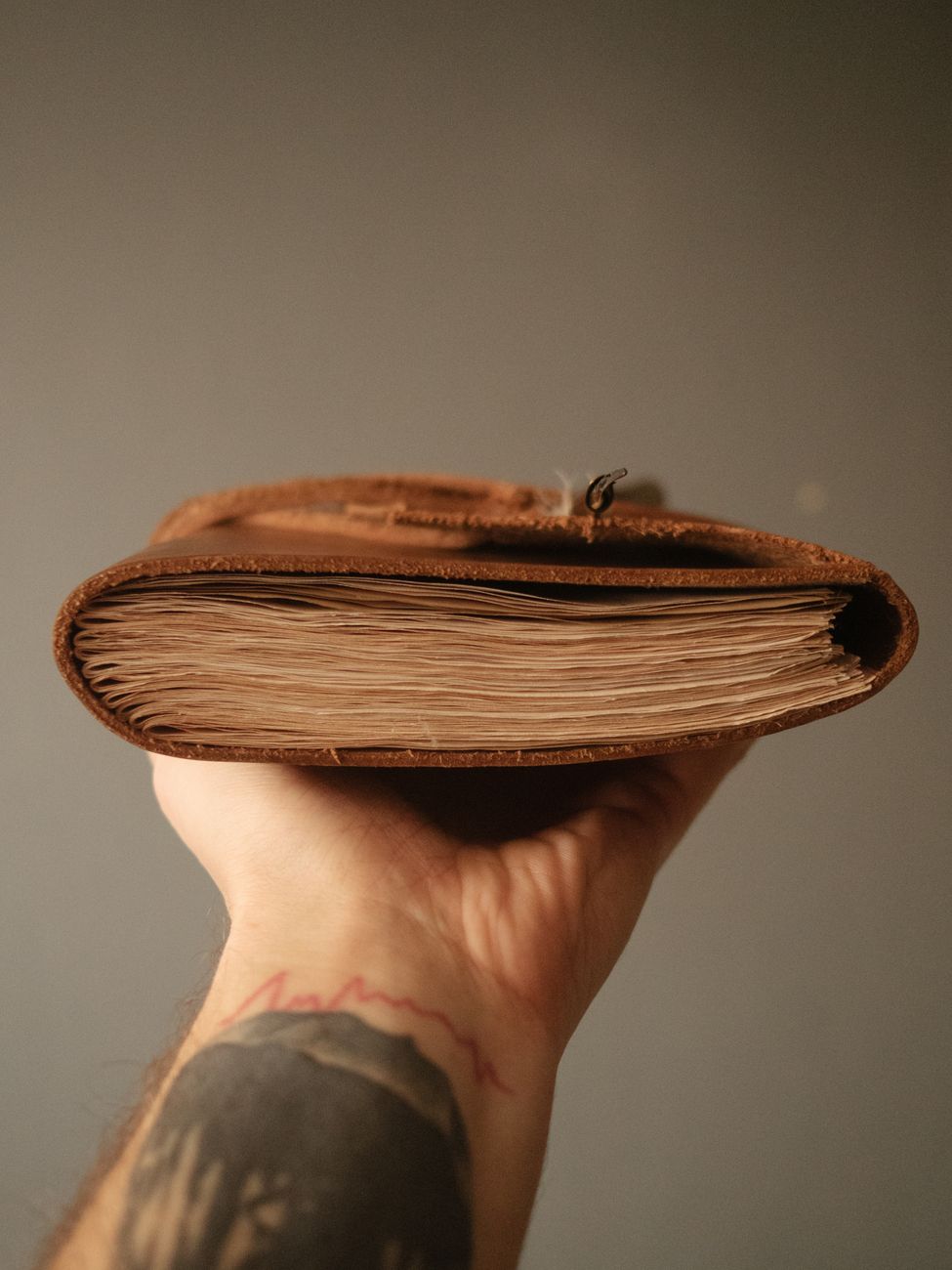
A refillable leather notebook cover — what stationery makers sometimes call a Cat-1 system — is a leather sleeve that holds one or more paper inserts by elastic band, snap, or friction alone, so the cover ages across decades while the paper inserts rotate every four to six months. I have kept four covers in daily rotation since 2018, and cataloged five more that entered the file long enough to be filed properly, refilled at least once, and photographed under raking light for stitch inspection. Retail prices in this dossier run from $45 at Chic Sparrow’s Basic Traveler to $180 at Galen Leather’s fully custom-stitched Deluxe. Weight ranges from 95 g at Foxy Fix Passport to 310 g at Popov Leather’s A5 wrap. Insert compatibility is the working question that separates cover-only systems from every other leather notebook category — get that right and one cover holds five decades of paper.
Why “cover” is a different animal from “notebook”
Before the specimen index, a note on classification. A fixed-block leather notebook (the Moleskine leather line, most Rustico journals, most Etsy makers) binds a paper block permanently into a leather cover — when the block fills, the entire book retires. A cover does not include the paper. It is a wrapper that accepts a paper insert cut to a standard format, and the primary trade of the category is that the cover cost is amortized across an unbounded number of inserts. My Midori camel-brown regular, filed in the leather notebook brands catalog, is now on its nineteenth insert — the leather has patinated visibly, and the paper has cycled roughly every four months across seven years.
The core insert format across every cover in this file is Traveler’s Company standard (approximately 110 × 210 mm regular / 89 × 124 mm passport). Traveler’s Company published the dimensions in 2006 and never trademarked them, so within four years the format became a de-facto industry standard. Chic Sparrow, Galen Leather, Foxy Fix, Popov Leather, Franklin-Christoph, One Star Leather Goods, Fine Leather Works, and roughly forty other makers all cut covers to this format. Inserts are made by Midori, Traveler’s Notes, Kobeha, Nanami, and half a dozen small paper mills — most standard 68 gsm tomoe river paper, some heavier Kokuyo blends, all interchangeable.
The one working number worth carrying: six millimeters of vertical elastic tension is the minimum that holds a full 96-page insert flat under a closed cover. Elastic-only systems that come in below that tension flap open in a bag. Every cover in the file below clears this bar.
Specimen index — TQC-2026-L002
The five refillable cover systems on file, cross-referenced at the material and construction level:
| Maker | Origin | Leather grade | Stitch style | Insert format | Retail range (2026) | Weight std. |
|---|---|---|---|---|---|---|
| Midori TRC | Tokyo, Japan · 2006 | Veg-tan oil-pull, thin (1.4 mm) | No stitch (folded) | TRC standard 110×210 | $60–95 | 160–190 g |
| Chic Sparrow | Provo, Nebraska, US · 2013 | Veg-tan pull-up, medium (2.2 mm) | Hand saddle-stitched | TRC standard + custom | $45–140 | 200–260 g |
| Galen Leather | Istanbul, Türkiye · 2014 | Full-grain veg-tan (2.4 mm) | Hand saddle-stitched | TRC + A5 + A6 | $55–180 | 210–320 g |
| Foxy Fix | UK-registered, EU-made · 2013 | Veg-tan Italian (1.8 mm) | Machine + hand finish | TRC + custom + A5 | £42–130 | 95–180 g |
| Popov Leather | Nelson, BC, Canada · 2013 | Full-grain Wickett & Craig (2.6 mm) | Hand saddle-stitched | TRC + custom + wrap | CA$95–210 | 240–310 g |
Two working numbers to carry from this table:
- Leather thickness sits between 1.4 mm and 2.6 mm across serious makers. Below 1.4 mm the cover flops in the bag; above 2.6 mm the closure elastic strains and the book becomes awkward on the desk. Midori’s 1.4 mm oil-pull is the thinnest workable spec because it uses a folded (no-stitch) construction — the leather itself does all the work.
- Hand saddle-stitch vs machine stitch is the visible-craft signal but not the durability signal. Machine-stitched covers (Foxy Fix’s mid-tier line, all Midori) hold structurally for decades because the thread type — waxed polyester or waxed linen — is the failure vector, not the stitch density. Hand saddle-stitch is worth paying for aesthetically and for repairability: a hand-stitched cover can be re-stitched by any leatherworker; a machine-stitched cover requires the maker to rebuild the seam.
Reading a cover the way an archivist reads a binding
The maker’s mark on a refillable cover is usually debossed on the back exterior or blind-stamped on the inside flap. Five details I check on any cover before it earns a catalog number:
- Stitch tension across the spine seam. Under raking light, a hand-saddle-stitched spine shows subtle tension variation every 3-4 stitches (human, not machine). A machine seam shows perfectly uniform indentation, which is fine for durability but tells you the price should be at the lower end of the tier. If a cover is priced above $120 and shows machine stitching, someone is marking up the origin story.
- Edge finish. Full-grain covers should have edges that are either left raw (Midori Traveler’s regular · left deliberately raw so it darkens with use), beveled and burnished with beeswax (Chic Sparrow, Galen · a warm honey-brown burnished edge), or hand-painted with edge-paint (Popov Leather Wickett & Craig line · very thin edge paint in a shade that matches the leather). Plasticky edge coatings mean corrected-grain or bonded material.
- Elastic anchor point. The vertical elastic that holds inserts is anchored either through a punched hole at top and bottom center of the cover (Midori, Foxy Fix), or through a spine-stitched channel (Chic Sparrow’s Deluxe / Bandolier construction). Punched-hole anchors are cheaper to make but slightly less durable at year 8+ (the leather around the hole widens with elastic pull). Spine-channel anchors distribute tension across the whole spine seam.
- Refill compatibility declared. A cover that lists exact insert dimensions on the maker’s page (e.g., “fits 110 × 210 mm regular size Traveler’s Notebook inserts”) is future-proof. A cover that markets only “fits our inserts” is a proprietary system — avoid unless the maker is Midori itself, since standard-format compatibility is what protects the buyer against maker discontinuation.
- Origin declared on the mark. “Made in Japan / Türkiye / Canada / UK” printed on the back is trust signal one. “Genuine leather” without country of origin is the FTC’s lowest-classified grade, below bonded. All five specimens in this file carry a specific country of manufacture.
Three tiers of entry into the refillable cover catalog
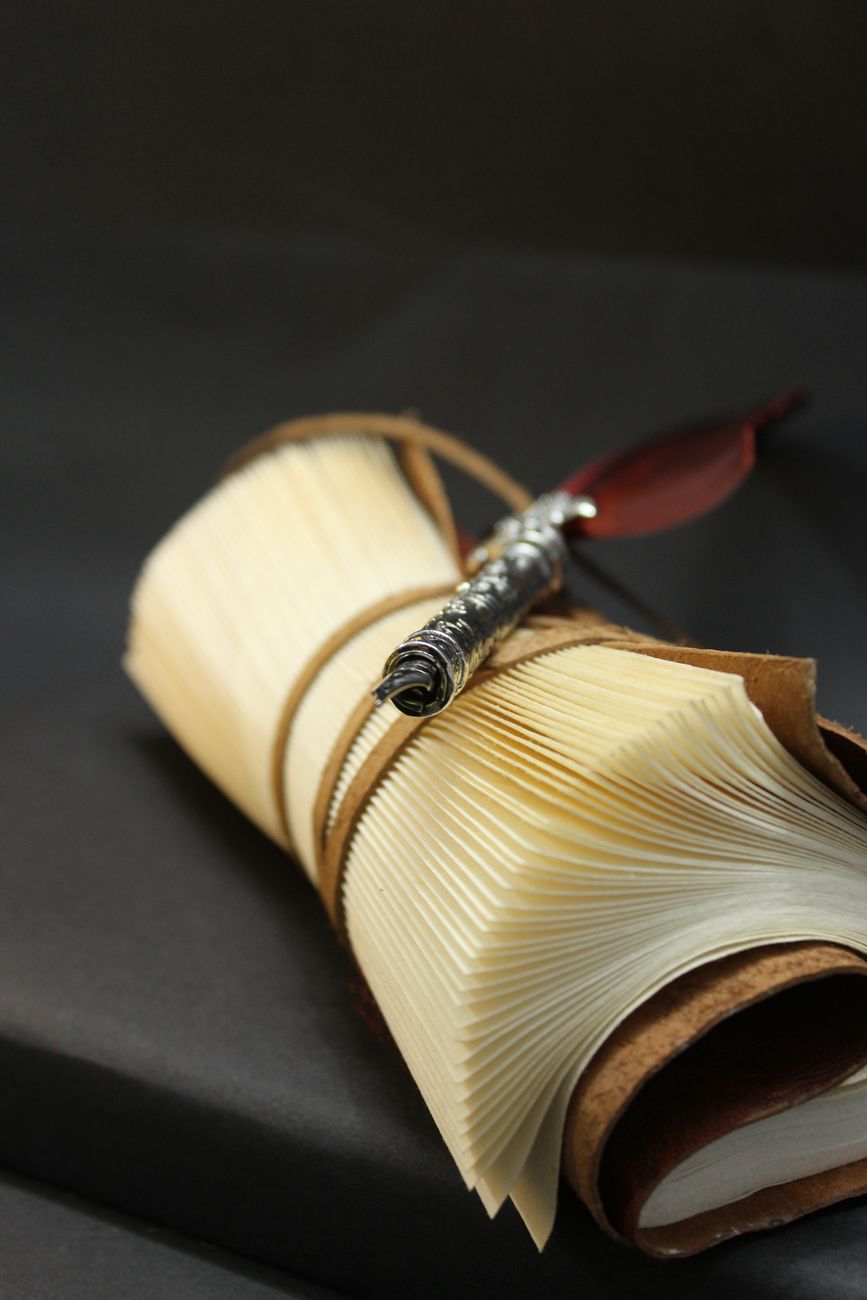
Three ways to enter the file, arranged by budget and by how much of the maker’s hand is visible in every cover.
The entry tier for refillable covers is a format decision, not a brand decision: any full-grain leather cover in standard TRC insert dimensions, at the price where a factory-cut cover with light machine finishing lives. The Midori Traveler’s Company regular in camel or brown — the original 2006 pattern — sits at $60-95 and is the reference specimen for every refillable cover made since. Foxy Fix, a UK-registered maker producing in the EU, sells TRC-compatible covers in bright colors and traditional finishes at £42-95 (roughly $52-118).
Filed since 2018 (Midori) and 2020 (Foxy Fix teal passport). The Midori camel-brown regular has developed a deep patina across the front spine where the elastic wraps daily, edge fray at the corners, and a slight bowing at the closure — all patina, none damage. The Foxy Fix passport carries a lighter aged look because the leather is 0.4 mm thinner; both covers accept the same insert format, which is the point of the entry tier.
The entry-tier trade-off is that machine-finished covers do not reward inspection under raking light the way saddle-stitched covers do. If you plan to keep the cover for decades, the mid tier below is where the visible craftsmanship starts to matter.
Chic Sparrow (Nebraska, US · founded 2013) is the American mid-tier reference: hand saddle-stitched TRC-compatible covers in six sizes and about a dozen finishes, cut by hand and stitched with waxed linen thread. Their Basic Traveler starts at $45; the mid-line Deluxe with pen loop and inside pockets runs $85-140. Chic Sparrow’s Etsy community documents the range of finishes — bourbon, chocolate, chestnut, oxblood — across ten years of production, which is the visibility rare in this category.
Galen Leather (Istanbul, founded 2014) covers the same tier from the other side of the world: hand-stitched, veg-tanned full-grain, in a wider range of hide finishes (Crazy Horse pull-up, oil-tan, olive, chestnut) and a broader size lineup including A5 and A6. Galen’s TRC-compatible covers run $55-180 depending on hide and custom stamping.
Filed since 2019 (Chic Sparrow Deluxe in bourbon) and 2020 (Galen A5 in olive Crazy Horse). Both covers show visible age at year 5-6 in the ways full-grain leather is supposed to: darkening at spine and corners, softening at the closure, no cracking or peeling anywhere. The Chic Sparrow’s linen thread has held under seven years of daily closure-open cycles.
The heirloom tier is Popov Leather in Nelson, British Columbia. The distinguishing feature is the hide: Wickett & Craig full-grain vegetable-tanned leather, 2.6 mm thick, from the last remaining bark-tanning tannery in Curwensville, Pennsylvania (est. 1867). Popov’s TRC-compatible cover runs CA$95-140; their A5 hardcover-wrap version — a folded envelope-style cover that accepts A5 hardback journals as inserts — runs CA$150-210.
Filed since 2021. The English tan A5 wrap I acquired that year has darkened from a bright caramel to a rich cognac across the front cover, and the hand-stitched spine shows tension pattern that resolves to a mechanically-consistent 7 stitches-per-inch under a jeweler’s loupe. The Wickett & Craig hide is what most serious leatherworkers would call the reference tannage — no competitor at retail matches its density, and Popov Leather is one of a small handful of makers cutting product from full 5-6 oz Wickett & Craig sides.
The Popov trade-off is size and weight (310 g for the A5 wrap) and price. At CA$210 for the largest wrap, it is a decade-plus purchase; if the wearer’s routine is passport-size and mobile, the entry Midori or mid-tier Chic Sparrow are better routine covers, and the Popov is a companion object for the desk rather than the bag.
How I decide when a cover enters the file
The catalog convention is twelve months of first-person use. For refillable covers, that measure works but the underlying discipline is longer — the interesting patina reveal is at year three, and the visible heirloom quality does not really appear before year five. What earns a file entry, in order:
- The cover lies flat after twelve months. Warping, curling, or bulging at the spine after a year of closure-open cycles is a construction failure — usually cheap thread, wrong-tension elastic, or overly-thick hide fighting the closure geometry.
- The elastic tension is still functional. Elastic bands stretch and lose tension across 3-5 years. A cover that is easy to replace elastic on (external threading, or a spine channel) survives the elastic swap; a cover where the elastic is glued or hidden requires the maker for a repair.
- The maker’s mark is legible at month twelve. Debossed marks fade — a mark flattened to nothing by year one usually indicates shallow deboss or soft leather priced above its grade.
- The insert format is still current. Standard TRC dimensions have been stable since 2006. A proprietary-format cover whose maker has since discontinued the insert is retired to the shelf; the file only keeps covers still in production at industry-standard sizing.
- The cover takes patina, not damage. Small scratches, dye softening at touch points, edge darkening at the spine — patina. Peeling top-coat, cracking corners, exposed cardboard through worn edges — damage, and the cover exits the file regardless of maker prestige.
Six specimens I have retired from the file since 2018 failed on the last two — bonded leather peeling within eighteen months, or a proprietary insert format that quietly stopped being sold. Those experiences underwrite the specimen index above.
Living with a refillable cover system
Two things about a seven-year refillable cover life that changed how I think about stationery:
- The insert decision becomes routine. By year three, the choice between Midori grid, dot, blank, and Kokuyo blend takes thirty seconds. Ritual replaced deliberation. I keep three inserts loaded in the Midori camel-brown at any time (dot for daily writing, blank for sketching, grid for planning), and rotate the completed one out every four months.
- The cover develops a cost pattern. A Midori regular at $75 plus roughly $6 per insert × 3 inserts a year over 7 years = $201 total. That is $29 per year for a system that has held its cover shape and elastic across seven years of daily use, and is projected to hold both for the next twenty. A comparable seven-year run of fixed-block Moleskine leather journals ($30 × 7 = $210, plus one book to shelve per year) works out to the same dollar cost — but produces seven artifacts to store and no accumulated cover patina.
If you have read my note on filing conventions, you know the twelve-month rule. In refillable covers the underlying discipline runs longer than twelve months because the reveal is patina and elastic-fatigue — both of which need three-plus years to file honestly. This dossier is what you read after that discipline has produced a five-cover working set worth publishing.
Frequently asked questions
What is the best leather cover for a notebook? For a daily desk or field use over five or more years, the reference standard is a full-grain vegetable-tanned Traveler’s Notebook-compatible cover, and the reference maker is Midori’s own Traveler’s Company (Tokyo, 2006). For hand-stitched craftsmanship at the mid tier, Chic Sparrow’s Deluxe or Galen Leather’s custom. For a heirloom purchase, Popov Leather’s Wickett & Craig line. “Best” depends on how much visible hand-stitching you want, but any of these five clear the entry bar of full-grain leather plus refillable industry-standard sizing.
Where can I find leather notebook covers? Directly from the maker is the reliable path — Midori/Traveler’s Company via specialty stationery retailers (JetPens, Baum-Kuchen, Pen Chalet) or their own site; Chic Sparrow and Foxy Fix through their own websites; Galen Leather at galenleather.com; Popov Leather at popovleather.com. Etsy hosts a large secondary ecosystem of small makers producing TRC-compatible covers (One Star Leather Goods, Two Sisters Leather, R.L.Winn), of which about a quarter enter the file after twelve months of testing. Retail stores rarely stock refillable covers at scale; the category is direct-to-consumer.
What is a notebook cover called? The industry-standard term is cover (specifically, “refillable notebook cover”). Historically the category was called a journal wrapper or portfolio; the Japanese-origin Traveler’s Company usage in 2006 popularized “Traveler’s Notebook cover,” which is now the umbrella term for the standard-format Cat-1 systems in this dossier. Alternate terms used by specific makers: “traveler journal,” “midori-style cover,” “leather sleeve.” All refer to the same object: a leather wrapper that accepts a paper insert rather than a bound block.
Where can I buy a leather cover (not from the maker directly)? Approved third-party retailers with reliable stock: JetPens (US · covers Midori, Traveler’s Company, some Chic Sparrow), Baum-Kuchen (US · Midori and small-maker curation), Pen Chalet (US · specialty pen store carrying leather goods), Nanami Paper (US · niche paper focus, some covers), Cult Pens (UK · European makers), Bureau Direct (UK), and Kinari (JP · direct Traveler’s Company retail). Amazon carries mostly unbranded knock-offs claiming TRC compatibility; the Amazon-only listings frequently fail on both hide quality and insert dimension accuracy, and do not enter the file.
How do I re-elastic a Traveler’s Notebook cover? Standard elastic is round elastic cord in 2 mm or 3 mm diameter, food-grade or medical-grade — Amazon, Etsy, or Michaels sell 5-meter spools for under $6. The replacement is roughly a twenty-minute job: remove old elastic (usually threaded through two punched holes at top and bottom of the spine), measure the vertical cover length plus 5 cm slack, cut two lengths, feed through the holes, and knot inside the cover. Video guides exist for every major maker’s construction (Midori’s is on Traveler’s Company’s own YouTube). Doing the replacement yourself extends cover life by 15-20 years and costs one dollar in cord.
Are Chic Sparrow covers hand-made or manufactured? Chic Sparrow is a small-workshop operation in Provo, Nebraska (founded 2013 by Deneen Robinson), with a team that hand-cuts and hand-stitches each cover to order. Production is not one-woman artisan work — the workshop employs roughly ten to fifteen leatherworkers at capacity — but every cover carries a signed maker’s mark and each seam is individually inspected. Turnaround is 6-12 weeks at retail; longer for custom builds. Chic Sparrow’s Etsy shop is separate from their main site and stocks pre-made inventory at faster turnaround for common finishes.
Read next
- Cataloged - Leather notebook brands — the parent dossier covering fixed-block and refillable categories side by side.
- Cataloged - Filson Mackinaw Cruiser — the fashion pillar opener.
- Cataloged - Leather laptop bags — the same hide-and-hardware read applied to carry.
- Filing conventions of the catalog — how entries earn their place.
- Publishing standards — what the catalog earns, what it does not.