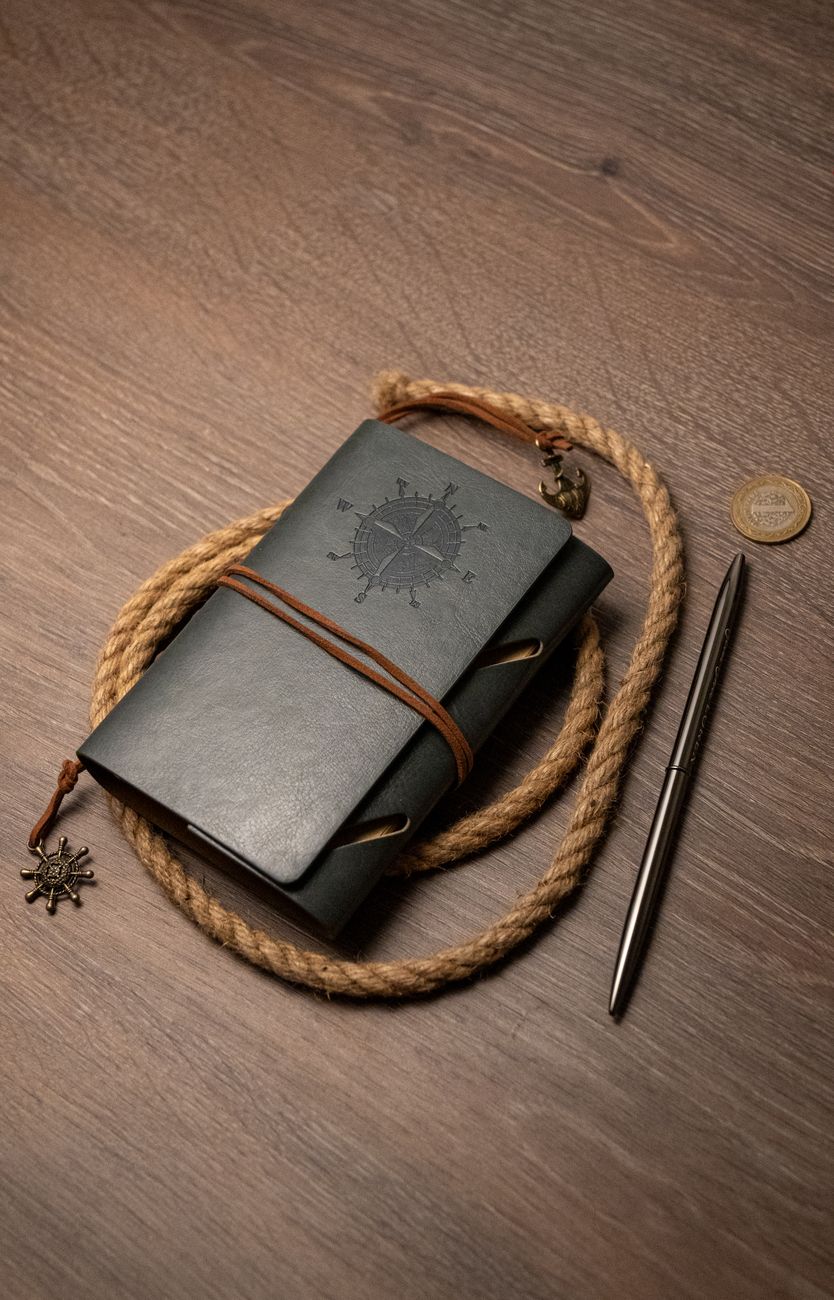
The notebooks on file, in one paragraph
Leather notebook, in this file, means a book with a functional writing block bound inside a hide cover — vegetable-tanned full-grain, chrome-tanned corrected-grain, or oil-tanned pull-up, in that order of longevity — with either a refillable insert system or a permanent stitched block, and a closure that is either an elastic band, a strap-and-buckle, or nothing at all. I have filled around fourteen of these across the last nine years of desk work, and the five in this dossier are the ones I have refilled or replaced twice or more, which is the working measure I care about. Retail prices in the file run from $32 at Rustico’s factory-second to €280 for a hand-glazed Il Bussetto. Weight ranges from 160 g (Midori Traveler’s Passport size) to 480 g (Paper Republic Grand Voyageur A5). Patina at year three looks different on every leather grade cataloged below; that difference is what most retail copy quietly declines to mention.
What “leather notebook” actually names, at the material level
Before the specimen index, a note on the classification. “Leather notebook” is not one product — it is at least three separable objects sold under one shelf label. Category 1 is the refillable cover system (Midori Traveler’s Company defined this in 2006): a leather sleeve holding one or more standard-format paper inserts by elastic band, so the cover ages and the inserts rotate. Category 2 is the fixed-block notebook (Rustico, Moleskine’s leather line, most Etsy makers): a stitched paper block permanently bound into a hide cover, replaced entirely when full. Category 3 is the custom-bound heirloom (Galen Leather, Il Bussetto, Paper Republic Grand Voyageur): a fixed block or refillable insert in a leather cover made to order, often signed by the maker, with hand-stitched spine detailing.
Each category ages differently and files differently. A category-1 cover accumulates seven or eight years of grain memory while the paper inside is on its thirty-fourth insert. A category-2 book fills up in six to twelve months and then joins a shelf as one dated artifact. A category-3 book is closer to a wedding-ring purchase — one book, kept refilled or reserved for a specific decade of writing. I file all three in the same dossier because the question “which leather notebook” almost always turns out to mean “which category first, then which maker in that category.”
The one working number worth carrying: for daily use at a desk, A5-ish (approximately 148 × 210 mm) is the size that survives. Passport size and pocket size are for field notes; anything larger than A5 stops sliding into bags. Every specimen below is A5 or A5-adjacent unless noted.
Specimen index — TQC-2026-L001

The five makers on file, cross-referenced at the material and binding level:
| Maker | Origin | Leather grade | Binding kind | Refill system | Retail range (2026) | Weight A5 |
|---|---|---|---|---|---|---|
| Midori TRC | Tokyo, Japan · 2006 | Vegetable-tanned oil-pull | Cover + elastic (Cat 1) | Standard TRC inserts | $60–95 | 160–190 g |
| Rustico | Provo, Utah, US · 2005 | Full-grain veg-tanned | Fixed block (Cat 2) | Not refillable | $32–95 | 260 g |
| Galen Leather | Istanbul, Türkiye · 2014 | Full-grain veg + Crazy Horse | Custom hand-stitched (Cat 3) | Refillable insert | $55–160 | 320 g |
| Paper Republic | Vienna, Austria · 2008 | Full-grain Italian veg-tanned | Grand Voyageur refillable (Cat 3) | Signature inserts | €95–165 | 380–480 g |
| Il Bussetto | Milan, Italy · 1980s (revived 2009) | Hand-glazed calf, patina-focused | Fixed block (Cat 3) | Not refillable | €120–280 | 240 g |
Two working numbers to carry from this table:
- Full-grain veg-tanned is the leather grade worth paying for. Full-grain preserves the entire skin surface (no correction, no top layer sanded off), so wrinkles, hair-follicle marks, and small scars remain — those are what develop the visible year-five patina. Chrome-tanned or corrected-grain leathers finish smoother out of the box but flatten to a plastic-like surface within eighteen months.
- Cat-1 refillable systems dominate long-term economics. A $75 Midori cover on its thirtieth insert has cost $75 for the cover plus $6 per insert times thirty — roughly $255 across ten years of daily writing. The equivalent thirty fixed-block Rusticos would run $32-95 × 30 = $960 to $2,850, and produce thirty distinct books to shelve rather than one aging cover to keep.
Reading a leather notebook the way an archivist reads a binding
The maker’s mark is usually on the inside back cover or debossed into the leather at the back edge. Five details I check on any leather notebook before it earns a catalog number:
- Grain direction and consistency. Look at the outer cover under raking light. A full-grain hide shows small variations (grain “flow lines,” pore density shifts, tiny scar marks) because it is one continuous piece of skin. A corrected-grain cover looks uniformly uniform — a giveaway that the top surface has been sanded and re-embossed with a fake grain pattern.
- Edge finish. The cut edge of a real full-grain cover is either left raw (Midori, Il Bussetto) or hand-burnished with beeswax (Paper Republic, Galen). A painted or plasticky edge coating suggests bonded leather or corrected grain under the cover.
- Stitching count per inch. A hand-stitched spine runs 6–8 stitches per inch with visible tension variation between stitches (human, not machine). Machine stitching runs 10–12 per inch, perfectly even. Both are functional; only the first tells you a person made it.
- Refill compatibility. Cat-1 covers that accept standard TRC insert dimensions (about 110 × 210 mm regular or 89 × 124 mm passport) are the future-proof choice — the format is now a de-facto industry standard, and refills are made by Midori, Galen, Traveler’s Notes, and half a dozen small paper mills.
- Origin declared on the mark. “Made in Italy” / “Made in Japan” / “Made in Turkey” printed on the back mark is trust signal number one. “Genuine leather” without country of origin is a red flag — genuine leather is the lowest classified grade under the FTC leather-labeling rules (below bonded).
Three tiers of entry into the leather notebook file

Three ways to enter the leather notebook catalog, arranged by budget and by how much of the maker’s process you want visible in every book.
Rustico is the American entry tier that does not compromise on the leather. Founded 2005 in Provo, Utah, they source full-grain veg-tanned hides from a small US tannery and sew the blocks on-site with linen thread. The Baladeo line (5 × 7 inch, fixed block, elastic closure) runs $45-65 at retail and $32-40 on their monthly factory-seconds sale. The Chronicle line (larger, 6 × 8 inch) is the mid-Rustico option at $85-95.
Filed since 2019. The Baladeo I bought that November has darkened from a mid-cognac to a deep bourbon color across the front cover; the corners have rounded and the elastic has been replaced once. The paper block held ink well (mostly Diamine and Iroshizuku fountain inks) with almost no bleed-through on the 80 gsm cream stock. Not refillable — when the block filled after roughly fourteen months of daily use, I retired it to the shelf and bought a second Baladeo in the same finish. The two books together look like a bookshelf-genealogy pair, which is a category-2 feature, not a bug.
The Rustico trade-off is that as a fixed-block cover it is a single-book commitment. The leather cover, however good, retires with the paper. If you want the cover to outlast the block, skip to the mid tier.
The mid tier is a format, not a brand: any full-grain leather cover in standard TRC insert dimensions (110 × 210 mm regular size, 89 × 124 mm passport size), plus a rotating stack of paper inserts from the small ecosystem of makers who cut to that size. Midori’s own Traveler’s Company cover — the original, 2006 — is the reference specimen at $60-95. Galen Leather in Istanbul makes a heavier, hand-stitched TRC-compatible cover at $85-160 in a range of finishes (Crazy Horse pull-up, olive, chestnut).
Filed since 2018. My Midori camel-brown regular is now on its eighteenth insert (mix of Midori grid, Midori dot, Traveler’s Notes blank, and one experimental Kokuyo insert). The cover has developed a deep patina across the front spine where the elastic wraps daily, a bit of edge fray at the corners, and a lopsided pouch where a business-card slip lives on the inside. Weight has stayed under 190 g for the whole time; total cost across seven years works out to $75 cover + roughly $110 in inserts = $185, or $26 per year.
This is the tier where the “one notebook, thirty years” fantasy becomes real. The cover outlives its owner. The paper rotates.
The heirloom tier is where two European makers I keep on file diverge but end up in the same file: Paper Republic Grand Voyageur (Vienna, refillable, category 3 by construction quality) and Il Bussetto (Milan, fixed-block, category 3 by hand-glazed patina work). Grand Voyageur A5 retails €95-165 depending on hide finish; Il Bussetto’s leather-bound A5 journal is €120-280 at their Milan flagship or approved European retail.
Filed since 2021. The Grand Voyageur I bought in Vienna that spring is on its eighth insert (Paper Republic’s own thread-bound inserts, 96 pages each, tomoe river 68 gsm — the paper stock fountain pen writers migrate to for zero bleed). The Italian tannage on the cover has taken a five-year lead over anything else in the file: the leather looks like it has been oiled monthly by a monk, though I have done nothing beyond hand-rubbing with a chamois every few months.
Il Bussetto’s hand-glazing is a separate craft entirely — the surface catches light unlike any other leather in this file. I own one Il Bussetto A5 (chestnut, retired to the shelf after twenty months of use) and would file a second at any point where I wanted the writing experience of a fixed-block book combined with an object I would leave to someone.
How I decide when a notebook enters the file
The catalog convention is that a piece earns a place after twelve months of daily use. For notebooks that measure is a bit different: I have retired notebooks after month four because the cover flattened, and I have kept books on the file after month fifteen even though they filled up in month eight. What actually earns a file entry, in order:
- The cover holds shape. After twelve months, the notebook should still open flat, close flat, and sit flat on a shelf. Warped covers, curled corners, or bulged spines are a sign the leather was corrected-grain or the paper was too thick for the binding.
- The paper block accepts real writing tools. Fountain pen ink at medium nib should not bleed to the reverse side of the page. Pencil should sharpen the paper’s tooth without shredding. If either fails at month three, the notebook does not enter the file regardless of how the cover ages.
- The refill system, if any, still fits the industry standard. Cat-1 notebooks whose proprietary insert size is discontinued or hard to source do not enter the file. This is why every TRC-compatible cover in this dossier is filed and no proprietary-format cover is.
- The maker’s mark is still legible at month twelve. Debossed marks fade — a mark that has flattened to nothing by year one usually indicates a shallow deboss or a soft leather that was priced too high for what it is.
- The book takes patina, not damage. Small scratches, dye softening at the touch points, deepening of color at the spine — those are patina and mean the leather is real. Peeling top-coat, cracking corners, or exposed cardboard through worn cover material are damage and mean the notebook was made from bonded leather sold as full-grain.
Five specimens I have retired from the file over the years failed on the last two points specifically — bonded leather cracking at the spine, or top-coat peeling within a season. Those experiences pay for the specimen index above.
Living with one leather notebook system
Two things about a fifteen-year leather notebook life that I did not expect at year one:
- The refill decision becomes routine, not agonized. In year one I stalled every time a Midori insert filled up, debating grid vs dot vs blank vs 68 gsm tomoe river. By year three the answer was always the same insert type I had been using, and the decision took thirty seconds at the checkout. Ritual replaced deliberation.
- The notebook develops a legible cost pattern. A Rustico Baladeo at $45 lasts fourteen months of hard use — that is $3.21 per month. A Midori cover at $75 plus $6-per-insert × three inserts a year is $1.75 per month across seven years. An Il Bussetto at €160 over the twenty months I used mine is €8.00 per month. All three are worth the money in the right context; the file exists precisely because you cannot answer “which one” without saying “for how long, and what for.”
If you have read my note on filing conventions, you know the twelve-month rule. For a leather notebook the underlying discipline is longer than twelve months — the interesting patina reveal is at month thirty-six, and the visible heirloom quality does not really appear before year five. This is the category where the catalog premise (“goods worth keeping”) does more literal work than in fashion or beauty.
Frequently asked questions
What are the most popular leather notebook brands? By retail volume and secondary-market visibility in 2026: Moleskine’s leather line (highest retail volume, weakest leather grade at that price), Midori Traveler’s Company (highest volume in the refillable-cover category), Rustico (largest US independent), Galen Leather (largest Turkish independent, huge online reach), and Paper Republic (highest European specialty visibility). This dossier files five specifically because a wider list stops adding information; Moleskine is intentionally excluded because their leather grade does not clear the entry bar despite the shelf presence.
What are some good quality leather notebooks? The working measure is full-grain vegetable-tanned leather with a functional refill or replacement pathway. That definition catches: Midori (refillable, category-1 reference), Rustico full-grain lines (Baladeo, Chronicle), Paper Republic Grand Voyageur, Galen Leather custom covers, Il Bussetto hand-glazed. Below that tier — Moleskine’s leather line, most gift-shop journals — the price-per-year cost climbs sharply because the cover retires before the paper does. Above it, custom bindery work from independent European craftsmen runs €300-800 and stops being about the notebook.
What are the best brands of notebooks (not necessarily leather)? For plain paper blocks, the standing consensus among paper reviewers is Leuchtturm1917 (Germany) for indexed dot-grid daily use, Midori MD (Japan) for premium 80 gsm cream stock, Rhodia (France) for fountain-pen-friendly Clairefontaine paper, and Field Notes (US) for pocket-format field logs. If leather is not a requirement, these four cover the same tier of paper quality at roughly one-third the price. The leather makes it a category-1 cover system or a category-3 heirloom; the paper alone is a category-2 utility purchase.
Why do some leather notebooks feel plasticky? Corrected-grain or bonded leather. Corrected-grain is real hide with the top layer sanded off and a synthetic finish applied over what remains; bonded leather is ground leather scrap suspended in a polyurethane binder. Both feel plasticky because they are plastic surfaces coated over some amount of hide. Neither develops patina — they wear down instead of aging in, and typically show damage (peel, crack) inside two years of daily handling. All five specimens in this file are full-grain, which is the category where the material feels warm to the touch and slowly darkens with hand oil.
How long should a leather notebook last? Category depends. A refillable Cat-1 cover in full-grain leather (Midori, Galen, Paper Republic) lasts 20-40 years of daily use — the leather outlasts the ownership, effectively indefinitely. A fixed-block Cat-2 notebook (Rustico Baladeo, most Etsy makers) is a 12-24 month service life, then retires to the shelf as a filled artifact. A Cat-3 heirloom fixed-block (Il Bussetto) sits somewhere in between — the cover would outlast the block, but the sentimental unit is book-as-object rather than cover-as-vessel.
Is a Midori Traveler’s Notebook worth the price? For daily desk or field use across five or more years, yes. At $75 for the standard-size cover plus roughly $6 per insert every 4-6 months of writing, the total cost of ownership lands under $200 across the first seven years — cheaper than replacing three or four Moleskines across the same window, and with a visibly better cover. For occasional gift-giving or a one-time journal (a trip, a course, a specific project), the Midori is priced above what a single-book use case justifies; the Rustico Baladeo at $45 is the better single-book answer.
Read next
- Cataloged - Filson Mackinaw Cruiser — the fashion pillar opener.
- Cataloged - British studio stoneware — the home pillar dossier.
- Cataloged - Single-ingredient skincare brands — the beauty pillar dossier.
- Cataloged - Leather laptop bags — the carry counterpart, filed by hide and hardware.
- Filing conventions of the catalog — how entries earn their place.